This [roadkill] is a relatively new source of fatality; and if one
were to estimate the entire mileage of such roads in the state, the
mortality must mount into the hundreds and perhaps thousands every 24
hours." (Joseph Grinnell, 1920) found on wildlifecrossing.net.
Crowd sourcing has yet another use. It turns out that there is significant scientific interest in roadkill. For example,
Over the last few decades, Eastern Fox Squirrel have been migrating from their original sites of invasion in California (Bay Area and Los Angeles) toward other areas, where they tend to displace the native Western Grey Squirrel. Because these two species are commonly-reported as roadkill, we can study their co-distribution and where Eastern Fox Squirrel have successfully invaded or are invading the habitat of Western Grey Squirrel. As you can see from the map below, there are several areas where only Eastern Fox Squirrel or Western Grey Squirrel occur and other areas, such as Sacramento, Santa Cruz, and Monterey Bay where both species occur. These mixing zones may indicate active invasion by the non-native species. (CROS Annual Report)
Knowing the locations of roadkill hotspots will also allow researchers to recommend best practices for road builders.
The states of California and Maine are now using an online reporting tool to track road kill. Anyone in those states can report identifiable roadkill using a web interface at http://www.wildlifecrossing.net/california/node/add/roadkill (registration required).
Is there an app for that? Turns out that the plans are in the works for one.
2012-01-25


2012-01-24
Rain 1.6"; season total 5.11"
We had the good fortune to pick up some rain over the weekend and Monday, bringing the season total to about 5" at my new house.
On 22 Jan in the morning, I measured 0.70" at my house (weather.com had it at 0.54" for my zip code) and 0.30" at the San Pedro annex.
We had a day of respite from rain and then on Tuesday I measured 0.9" in my backyard that had fallen the day before. For the same time period the San Pedro annex was about 0.7". Weather.com put this rainfall at 0.6" in my zip code, so it looks like I'm running a bit ahead of the official figures.
A high degree of variation is expected between the San Pedro annex, my house, and the official figures for my zip code due to the large variation in topography in the area.
Some unreported (on this blog) previous rainfall:
11-Dec 0.60"
17-Dec 0.10"
18-Dec 0.01"
- Posted at great expense from my iPhone
On 22 Jan in the morning, I measured 0.70" at my house (weather.com had it at 0.54" for my zip code) and 0.30" at the San Pedro annex.
We had a day of respite from rain and then on Tuesday I measured 0.9" in my backyard that had fallen the day before. For the same time period the San Pedro annex was about 0.7". Weather.com put this rainfall at 0.6" in my zip code, so it looks like I'm running a bit ahead of the official figures.
A high degree of variation is expected between the San Pedro annex, my house, and the official figures for my zip code due to the large variation in topography in the area.
Some unreported (on this blog) previous rainfall:
11-Dec 0.60"
17-Dec 0.10"
18-Dec 0.01"
- Posted at great expense from my iPhone
2012-01-19
Knitted chain link
This is firmly in the camp of "What will they think of next?".
This isn't breaking news, but it's worth retelling. From http://www.architerials.com/:
Dutch design firm Demakersvan has produced a line of chain link fence that incorporates the ancient craft of lace-making into the fabrication of industrial chain link fence, taking something which was meant to be purely functional and gently encouraging it to be decorative. Think of Lace Fence as your Blanche Devereaux fencing option: it’s a flirty southern charmer with a stubborn streak and perhaps a little bit of a temper.
 Get more information from the source, lacefence.com
This isn't breaking news, but it's worth retelling. From http://www.architerials.com/:
Dutch design firm Demakersvan has produced a line of chain link fence that incorporates the ancient craft of lace-making into the fabrication of industrial chain link fence, taking something which was meant to be purely functional and gently encouraging it to be decorative. Think of Lace Fence as your Blanche Devereaux fencing option: it’s a flirty southern charmer with a stubborn streak and perhaps a little bit of a temper.

Napa river walk
Juli and I had a nice vacation in northern California over New Years. We stayed in the town of Napa, which has a certain amount of appeal all on it's own, even leaving aside the fact that it's the gateway to the Napa Valley wine region. Napa celebrates its river in ways that we don't see much of here in Los Angeles.
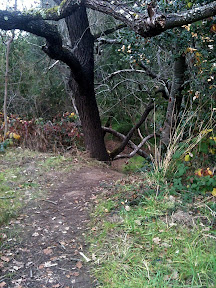
Near the place we stayed is a 1.2 mile paved trail that runs along the Napa river.
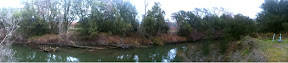

Interesting side paths go down to the river's edge.
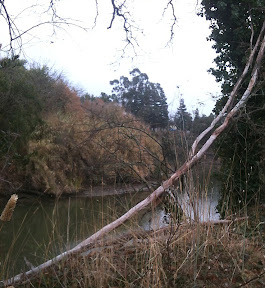
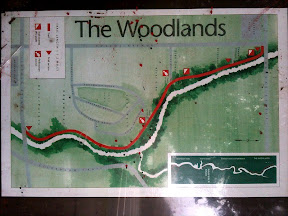
I think we stayed at River Pointe - a timeshare. The buildings are all mobile and the infrastructure is designed to accommodate seasonal flooding. These fences pivot as water washes by but that wasn't a concern for us: all the locals were commenting on the lack of rain when we were there.

- Posted at great expense from my iPhone
Near the place we stayed is a 1.2 mile paved trail that runs along the Napa river.
Interesting side paths go down to the river's edge.
I think we stayed at River Pointe - a timeshare. The buildings are all mobile and the infrastructure is designed to accommodate seasonal flooding. These fences pivot as water washes by but that wasn't a concern for us: all the locals were commenting on the lack of rain when we were there.
- Posted at great expense from my iPhone
2011-11-23
Calflora Mobile Search
Following on the previous blog post, also available from Calflora Calflora Mobile Search for plants, an interface to the Calflora database for mobile devices. Click on a plant name, and you will see one or two photos of the plant. Works on Android and iPhone. Check the current location box and (courtesy of HTML5) it will limit the search to plants observed growing near wherever you are.
Calflora Observer app for Android and iPhone
Back in last year's blog post "Ready to go live with What's Invasive!" I wrote about a smart phone app called What's Invasive!, an application used for mapping invasive plants.
The makers of What's Invasive! have teamed with Calflora to make the Calflora Observer Observer smart phone application with the purpose of making observations of wild plants, including photos, on your Android or iPhone. It's a free download and I'll be firing it up soon. Whereas What's Invasive relied on user- or community-defined plant lists, Observer allows reporting of any plant.
The makers of What's Invasive! have teamed with Calflora to make the Calflora Observer Observer smart phone application with the purpose of making observations of wild plants, including photos, on your Android or iPhone. It's a free download and I'll be firing it up soon. Whereas What's Invasive relied on user- or community-defined plant lists, Observer allows reporting of any plant.
2011-11-21
Rain 0.875"; season total 2.805"
We had a nice rain storm yesterday and accumulated 0.875" in my back yard over the day.
Recent rains have been:
6 Nov 0.24"
12 Nov 0.26" fell the day or night before
13 Nov 0.01"
21 Nov 0.875"
Recent rains have been:
6 Nov 0.24"
12 Nov 0.26" fell the day or night before
13 Nov 0.01"
21 Nov 0.875"
2011-11-17
The ants go marching
I got this link to "17,000 Species in the Great Smoky Mountains. And Counting" (http://www.metropulse.com/news/2011/nov/16/17000-species-great-smoky-mountains-and-counting/) from my native plant listserv courtesy of Jeffrey Caldwell, along with an interesting observation from that report:
“...most of the plant species that you see in the Great Smoky Mountains National Park rely on ants to disperse their seeds,” Sanders says. “So one of the things we did was just put out seeds and look at what happened to them. And 166 out of 167 times, one ant species carried the seed away. So even though there there’s a lot of biodiversity in the Smokies, there’s some species that do a lot.” If one of those super-species was threatened by changes in its habitat, it could have wide-ranging consequences.
Most native plant fanciers appreciate the role of insects in the food web, but the role of ants was previously unknown to me. I seem to recall that a native (and distinctly larger) black ant was more plentiful when I was growing up, but I have hardly seen them recently. I think they've been supplanted by Argentine ants all along the western coast of the US.
“...most of the plant species that you see in the Great Smoky Mountains National Park rely on ants to disperse their seeds,” Sanders says. “So one of the things we did was just put out seeds and look at what happened to them. And 166 out of 167 times, one ant species carried the seed away. So even though there there’s a lot of biodiversity in the Smokies, there’s some species that do a lot.” If one of those super-species was threatened by changes in its habitat, it could have wide-ranging consequences.
Most native plant fanciers appreciate the role of insects in the food web, but the role of ants was previously unknown to me. I seem to recall that a native (and distinctly larger) black ant was more plentiful when I was growing up, but I have hardly seen them recently. I think they've been supplanted by Argentine ants all along the western coast of the US.
2011-11-09
Native plant detective story - Aesculus californica
I was leaning against the bar in a speakeasy in Malaga Cove, waiting for Juli to finish her Christmas shopping, when a girl got up from the table where she had been sitting with three other people and came over to me. She was small and blonde, and whether you looked at her face or at her body in powder-blue sport clothes, the result was satisfactory. "Aren't you Brent?" she asked.
I said: "Yes."
She held out her hand. "I'm Dorothy Aesculus. You don't remember me, but you ought to remember my father, Bucky Aesculus. You-"
"Sure," I said, "and I remember you now, but you were only a kid of eleven or twelve then, weren't you?"
"Yes, that was eight years ago. Listen: remember those stories you told me? Were they true?"
"Probably not. How is your father?"
She laughed. "I was going to ask you. Mamma divorced him, you know, and we haven't heard from him since 2005. Don't you ever see him?"
My glass was empty. I asked her what she would have to drink, she said Scotch and soda. I ordered two of them and said: "No, I've been driving and hiking all around, but I haven't seen him."
She said slowly: "I'd like to see him. Mamma would raise hell if she found it out, but I'd like to see him."
"I would too. And?"
"He's not in the phone book or city directory."
"Try his lawyer," I suggested.
Her face brightened. "Who is he?"
"It used to be a fellow named Jep-something-or-other-Jepson, that's it, Jepson Herbarium. He was in the Singer Building."
"Lend me a nickel," she said, and went out to the telephone.*
Well, it wasn't as dramatic as all that.
One of the fun things about a new garden is the time you spend before you plant, planning the whole thing. Gardening is work and you expect to break a sweat doing it. But in the planning stages you can live in a sort of Platonic ideal of a garden - filled with possibilities and not one drop yet of sweat.
I was spending some time considering the merits of California Buckeye (Aesculus californica) as a yard tree and went looking for data supporting its presence on the Palos Verdes Peninsula. It's a signature tree of my summer travels to northern California and I like it a lot. Aesculus is one of the hallmarks of my summer travels with great looking new foliage, followed by 6 inch or longer flower spikes, and a distinctive early browning of leaf color before it loses them all.
However, I was regretful that I hadn't noted any in my travels around my neighborhood. They are distinctive trees. A few idle minutes with my underworld informants told me that there was information to be had in the Jepson Herbarium. Sure enough, an occurrence was noted near Malaga Cove, but there was only one reported sighting from 2005 that noted only two trees, so anything could have happened in the intervening years! Were they the last ones? I got a little excited about rediscovering what seems to be a rarely occurring native tree in Palos Verdes. Maybe there was no trace left? Maybe there was only one or none left! The thrill of the hunt is similar to that of geocaching, except that the trees I was looking for could be well hidden or even extirpated.
 Hot on their trail, this morning I went on a little walk and found what I think were two spindly looking, multi-trunked, Aesculus. I saw no dried flower spikes or fruits which would have made identification easier, possibly due to the poor health of the trees. However, I had also expected either bare branches or completely brown foliage at this time of year based on what I know of the tree in N. California. What I found were leaves still on the tree with a color that I'd expect to see no later than mid summer in hotter inland N. California areas. See the photo of a typical leaf that I found on the ground nearby. The local climate is much cooler in summer and warmer in winter than N. California, so perhaps that explains the late autumn colors. Otherwise, it seems to match to Aesculus Californica. I've emailed some local experts for more info.
Are these are in fact PV-native or transplants? Truly local plants will probably have genetic variations that are specific to their regional microclimate. Are there other stands of Aesculus elsewhere on the Peninsula? Seems like there's a sequel in the making.
*Stolen without regret from Dashiell Hammett's The Thin Man
2011-11-05
Rain 0.20"; season total 1.42"
We had rain again last night of 0.20". I had regretted not having my rain gauge out in the yard for the first storm of the season in early October, but I found an old dog bowl in my back yard after that storm and measured the water in it to to get a handle on that storm's rain: 1.22 inches! Based on the location of the dog bowl (out in the clear) I think it was a true reading even though 1.22" seems like a lot of rain. I'll go with it for now as the official first rainfall of the season at my new home and feel good about having a complete record for this season.
The San Pedro annex, only 10 minutes by car away, received 0.35" of rain to my 0.20".
The San Pedro annex, only 10 minutes by car away, received 0.35" of rain to my 0.20".
2011-10-26
Local trails and busy but not forgotten
I'm busy doing some things other than blogging. One of the fun things I'm doing is familiarizing myself with local trails. It turns out there are plenty of obscure and undocumented ones, such as the "Mailbox Trail" which quickly devolves into a single track along the edge of George F Canyon.
 George F turns into another canyon system further along, and the trails are wide and well maintained in this area (for horses).
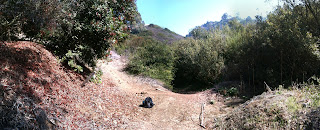
That's Toyon (Heteromeles arbutifolia) on the left with the red berries and Lemonade Berry (Rhus integrifolia) looming over the right hand branch of the trail. They're easy to tell apart this time of year with the red berries only on Toyon, which is also known as Christmas Berry. When they are not in bloom, I think the easiest way to tell them apart is by the leaf edges: Serrations on the Toyon, smooth or wavy on Lemonade Berry. This seems to be locally true, anyway.
I have been assured that all trails are public access, yet already I've run into what appear to be bogus trail closings promulgated by local homeowner groups (thinks to self, "Hmm. I don't see the advertised trail hazard that motivated trail closure with not one but two chain link fences across the trail. Curious - these fences seem designed to cut off down-trail access into a gated community that is advertised as open at the public-access trailhead. Wow, even the horsemen passing within eyeshot of the trail closure don't seem to think there's a hazard.")
I sense some advocacy in my future. Until then, I'm just a quiet trails anthropologist and I'll keep a photo record documenting trail conditions without trying to perturb the system.
I'll be back in a bit to tell you more about native plants - I have tremendous plans for my new yard. Until then, I'm a bit busy. See you on the trails.


That's Toyon (Heteromeles arbutifolia) on the left with the red berries and Lemonade Berry (Rhus integrifolia) looming over the right hand branch of the trail. They're easy to tell apart this time of year with the red berries only on Toyon, which is also known as Christmas Berry. When they are not in bloom, I think the easiest way to tell them apart is by the leaf edges: Serrations on the Toyon, smooth or wavy on Lemonade Berry. This seems to be locally true, anyway.
I have been assured that all trails are public access, yet already I've run into what appear to be bogus trail closings promulgated by local homeowner groups (thinks to self, "Hmm. I don't see the advertised trail hazard that motivated trail closure with not one but two chain link fences across the trail. Curious - these fences seem designed to cut off down-trail access into a gated community that is advertised as open at the public-access trailhead. Wow, even the horsemen passing within eyeshot of the trail closure don't seem to think there's a hazard.")
I sense some advocacy in my future. Until then, I'm just a quiet trails anthropologist and I'll keep a photo record documenting trail conditions without trying to perturb the system.
I'll be back in a bit to tell you more about native plants - I have tremendous plans for my new yard. Until then, I'm a bit busy. See you on the trails.
2011-10-14
Charlotte to Charlie to Charles to Chuck
There were several if these large spiders around the house a couple weeks ago. They were at my old house too until they mysteriously disappeared - I think the neighbor sprayed.
This one started as a relatively petite Charlotte and ended as thuggish Chuck over a couple week period of time.
The camera angle makes it appear that there's a large blurry spider on my lawn, but it's really just 50 cent piece sized spider in the foreground of the shot.

- Posted at great expense from my iPhone
This one started as a relatively petite Charlotte and ended as thuggish Chuck over a couple week period of time.
The camera angle makes it appear that there's a large blurry spider on my lawn, but it's really just 50 cent piece sized spider in the foreground of the shot.
- Posted at great expense from my iPhone
2011-10-05
First rains of the winter
I'm happy that we're getting some rain. Often it will rain in October and then be dry again until much later in the year, so an early start on the winter rains isn't necessarily a harbinger of a wet winter. Traffic was typically slow yesterday morning and this morning due to our first rain of the year: We had a small amount of rain yesterday A.M. and more today that appears to be making more of a lasting impression.
My new house is in a rain "shadow" on the east side of a coastal hill. As I drive around the hill on which I live each morning, I've noticed that my east facing, leeward, side of the hill seems to consistently have less moisture than the ocean side. This seems an intuitive result for storms arriving from the ocean and it's also true for fog, which can be a significant contributor to soil moisture.
Sadly, my rain gauge is not out in the yard yet so I'll have to make an educated guess on the precipitation from this storm. I would have liked to start the winter with some solid measurements.
Addendum: I found an old dog bowl in the yard with 3.1 cm of water in it, so I'm going with rainfall of 1.22". That's a lot!
My new house is in a rain "shadow" on the east side of a coastal hill. As I drive around the hill on which I live each morning, I've noticed that my east facing, leeward, side of the hill seems to consistently have less moisture than the ocean side. This seems an intuitive result for storms arriving from the ocean and it's also true for fog, which can be a significant contributor to soil moisture.
Sadly, my rain gauge is not out in the yard yet so I'll have to make an educated guess on the precipitation from this storm. I would have liked to start the winter with some solid measurements.
Addendum: I found an old dog bowl in the yard with 3.1 cm of water in it, so I'm going with rainfall of 1.22". That's a lot!
2011-10-01

Subscribe to:
Posts (Atom)