From Ars Technica, an interesting study about the Pinyon pine and its fungal associations.
...
Researchers took seeds from drought-tolerant and drought-intolerant
trees, then exposed them to soil containing fungal communities from both
drought-tolerant and drought-intolerant roots. Even when grown with the
opposite soil, the seeds ignored the local fungal community; both
drought-tolerant and drought-intolerant seeds still cultivated the same
species of fungus as their adult forbears.
It turned out that the inheritance of the fungus is what actually
made the different trees drought-tolerant or drought intolerant; seeds
from drought-tolerant mothers only grew larger than their
drought-intolerant cousins when in the presence of their attendant
fungi. The tree’s genetics simply helped it recruit specific species of
fungi.
...
Showing posts with label soil. Show all posts
Showing posts with label soil. Show all posts
2017-09-29


2012-02-09
Potting Woodwardia and Satureja
Here's how I planted Giant Chain Fern (Woodwardia fimbriata) and Yerba Buena (Satureja douglasii) using a new (to me) potting mix.
The main ingredients of my potting soil mix: red lava rock, potting soil, and builders sand.
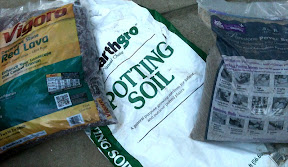
The builders sand has gravel up to about 1/2" in length and down to 1/16" or slightly under. The mix ratio was one bag of lava, one bag of builders sand and one bag of potting soil for a volume ratio of 1:1:2. Not shown is the Osmocote slow release fertilizer that I added in lesser amounts than I thought the directions called for.
Here's what the mix looked like on the blade of my spade - the gravel and lava are not as apparent as one might think given that they make up 50% of the mix.
The main ingredients of my potting soil mix: red lava rock, potting soil, and builders sand.
The builders sand has gravel up to about 1/2" in length and down to 1/16" or slightly under. The mix ratio was one bag of lava, one bag of builders sand and one bag of potting soil for a volume ratio of 1:1:2. Not shown is the Osmocote slow release fertilizer that I added in lesser amounts than I thought the directions called for.
Here's what the mix looked like on the blade of my spade - the gravel and lava are not as apparent as one might think given that they make up 50% of the mix.
2012-02-08
A new take on potting soil
There's a Goldilocks Principle for everything, including potted plants. Realizing this, I have a new (for me) philosophy for potting plants. I needed one since I had a dangerously cavalier attitude to the potting soil I used: Recycled
soil from other potted plants? OK. Running low? Add some garden
soil. Fertilizer? Yes or No, but probably not at the right times.
2010-11-15
Rain barrel vs. soil
You are a rain barrel stud, but you're beginning to feel a slight unease. Your sense of equanimity is a little disturbed because you've been reading this blog. You figured out that tap water costs next to nothing, so the $500 you spent on rain barrels is beginning to chafe in your tender areas - not only is there no benefit during the majority of the year when we have no rain in our Mediterranean climate, but the barrels aren't the most aesthetic or space-efficient addition to your yard. You want to do the right thing for the environment and a casual survey of your yard during the last rain storm suggested that next to the quantity of rain running off your driveway and out to the street, your rain barrels were looking a little...paltry.
2010-11-10
Soils primer
I was guilty, just like many of you. I went through the gardening motions of tilling, composting, cover cropping, and mulching without a good understanding of their real impact. I despise unthinking orthodoxy even if I believe it's correct, and I ought to have applied that philosophy closer to home. For all my belief in the value of soil improvement I could have been speaking cavemanese when it came to a real sophisticated rationale behind my belief: "Compost gud. Mulch gud. Make gud soil." It took me a while, but I've finally made sense of a number of soils issues that were flitting about the corners of my mind.
It turns out that there's a useful level of understanding for gardeners a step or two above the cavemanese or dummy level. While there's plenty of web information on the necessity of mulching and composting those articles are are often little better than my cavemanese since they don't provide a scientific or evidence-based rationale. I'll try to leave that sort of writing for the garden mulch sycophants, color-by-number recipe followers, and garden hangers-on and instead give you a little bit of an empirical soil science rationale behind the seven pillars of garden soil maintenance.
It turns out that there's a useful level of understanding for gardeners a step or two above the cavemanese or dummy level. While there's plenty of web information on the necessity of mulching and composting those articles are are often little better than my cavemanese since they don't provide a scientific or evidence-based rationale. I'll try to leave that sort of writing for the garden mulch sycophants, color-by-number recipe followers, and garden hangers-on and instead give you a little bit of an empirical soil science rationale behind the seven pillars of garden soil maintenance.
Subscribe to:
Posts (Atom)