I hear a lot of people saying that this winter is the driest on record, but that doesn't seem true to me - at least not yet. Still, the local NBC station is stating, "Never has Los Angeles gotten less rain than during the calendar year
that will end New Year's Eve. Patrick Healy reports for the NBC4 News at
6 p.m. on Friday, Dec. 27, 2013."
I think it's only the driest that people can remember. Since people's memories seem to only go back a few years, this isn't surprising.
At this point in the season I've measured 1.36" in my back yard and the NBC affiliate is claiming 3.6" at USC. That's a low water year for certain. However to the degree that I can directly compare either amount to data archived at NOAA, it's not the worst on record. As recently as Jan 31 of 2007, the dataset that I downloaded from NOAA indicated 1.27" and on the same date in 1999 it indicated 1.19". Jan 31, 1974 LA reported 0.34" cumulative rainfall and in 1962 reported 0.72"! How's that for dry?
What can be going on with those numbers? Why don't they agree better? I think the answer is that weather is doing what it does best: varying (by location). In this case it looks like the reporting locations of USC and the dataset I have from NOAA are not the same. However, I think we can all agree that it is dry.
Water your native plants well now!
2014-01-14


2014-01-01
Rain barrel rethink?
There is widespread concern over our lack of rain in Southern California so far this year. (If you have natives, now is the time to water deeply so that they last through the summer). In these circumstances, attention naturally turns to using water more effectively.
I've been opposed to rain barrels as an effective means of storing water since our typical rainfall pattern makes them very inefficient. The storms that drop enough water to run off also drop far more than can be effectively stored in a typical 50 or 100 gallon barrel storing run off from a typical roof pitch: It's far better to just keep the water on property in the ground. Of course this assumes that you can create or already have a suitable retention and infiltration area (for many homes this is a lawn area). Also, I think that my analysis was confined to 50 gallon or 100 gallon barrels.
This 350 gallon tank with manifolded drip system is temporarily watering a native plant restoration site in Lunada Canyon, but it reminded me of my rain barrel analysis that condemned their effectiveness.

You'd have to reconcile the industrial look of this barrel with your garden. Perhaps a location in a service yard or behind a screen would make sense.

You wouldn't want to integrate a pump due to the added complications, but if you wanted to keep a hillside watered from above, then this gravity system might be the ticket.
Sent from my iPhone at great expense
- Posted from my iPhone
I've been opposed to rain barrels as an effective means of storing water since our typical rainfall pattern makes them very inefficient. The storms that drop enough water to run off also drop far more than can be effectively stored in a typical 50 or 100 gallon barrel storing run off from a typical roof pitch: It's far better to just keep the water on property in the ground. Of course this assumes that you can create or already have a suitable retention and infiltration area (for many homes this is a lawn area). Also, I think that my analysis was confined to 50 gallon or 100 gallon barrels.
This 350 gallon tank with manifolded drip system is temporarily watering a native plant restoration site in Lunada Canyon, but it reminded me of my rain barrel analysis that condemned their effectiveness.
You'd have to reconcile the industrial look of this barrel with your garden. Perhaps a location in a service yard or behind a screen would make sense.
You wouldn't want to integrate a pump due to the added complications, but if you wanted to keep a hillside watered from above, then this gravity system might be the ticket.
Sent from my iPhone at great expense
- Posted from my iPhone
2013-12-20
Sunset with Lemonade Berry

2013-12-10
October to November garden
Back on October 7, my bulbs started greening up. First the Crocus sativus (Saffron Crocus)
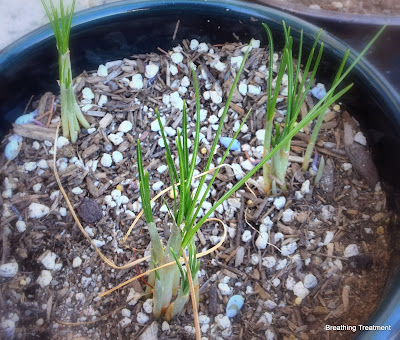 By November 22, the C. sativus had grown a bit:
 Native bulbs were showing some life too by Nov 22. Don't ask me just now which one this is.

On Oct 7 the unknown exotic was just showing:
 I planted this Sedum 'Harvest Moon' just before Thanksgiving and took these pictures on 12/9. It's fragile and I placed the broken bits in other nearby pots where it looks like they will take. I may be overwhelmed with it by next year.

I think these are Datura wrightii (Loco weed, sacred Datura) seedlings. At least, that 's what I scattered in this container just before Thanksgiving. The picture was taken on 12/9. A companion container planted at the same time isn't showing any growth, however, so these may be adventitious sprouts.
 I think this is Dichelostemma capitatum (Blue Dicks), a bulb native to western N. America.
 Manzanita flowers are beautiful and delicate. It looks like a ruthless pollinator has gotten into this one from the side. That happens.

Finally, I found these fun mushrooms the other day and chose them to make a "family" portrait on 12/9. We'll see how fast they grow ;-)


On Oct 7 the unknown exotic was just showing:


I think these are Datura wrightii (Loco weed, sacred Datura) seedlings. At least, that 's what I scattered in this container just before Thanksgiving. The picture was taken on 12/9. A companion container planted at the same time isn't showing any growth, however, so these may be adventitious sprouts.


Finally, I found these fun mushrooms the other day and chose them to make a "family" portrait on 12/9. We'll see how fast they grow ;-)

2013-12-09
Rain 0.27"; season total 1.36"
In the last two years we've had over 2" cumulative rainfall by early December at my current address. As of today, we have 1.36" total in my back yard. However, don't lose heart for a wet winter: California often has highly variable rainfall and neither of the figures I just mentioned is out of bed for a typical (50% of the time) water year. Based on 1944 to 2010 rainfall records, the median rainfall for Los Angeles changes from 1.06" to 2.30" from the end of November to the end of December. So far we're typical.
29-Nov 0.40" - This could have been greater. I checked it a day or two after the storm went through so evaporation could have reduced it.
7-Dec 0.27"
Total: 1.36" (or a bit larger since I dilly dallied in making a record of the 0.40" rainfall)
29-Nov 0.40" - This could have been greater. I checked it a day or two after the storm went through so evaporation could have reduced it.
7-Dec 0.27"
Total: 1.36" (or a bit larger since I dilly dallied in making a record of the 0.40" rainfall)
2013-12-08

2013-11-21
Rain 0.54"; season total 0.69"
We had a late October start to our rainy season this year and then nothing much (some trace amounts that I don't record) until last night when we had a steady light rain that dropped over 0.5 inch. This is just the sort of rainfall that gardeners like - the kind that soaks in.
The 27 Oct date for the start of our measurable rainfall is the latest that I've measured since I started keeping track in 2004. However, median LA rainfall in November is just under 1" (0.93") and we are not out of bed with that guideline, yet, particularly with rain still in the forecast.
Date Amount Total
27-Oct 0.15" 0.15"
20-Nov 0.54" 0.69"
The 27 Oct date for the start of our measurable rainfall is the latest that I've measured since I started keeping track in 2004. However, median LA rainfall in November is just under 1" (0.93") and we are not out of bed with that guideline, yet, particularly with rain still in the forecast.
Date Amount Total
27-Oct 0.15" 0.15"
20-Nov 0.54" 0.69"
2013-10-22
Euphorbia terracina
Here's a weed that's easy to pull and one where you might feel that an investment of time now will have a real preventive impact. The weed is Euphorbia terracina (Geraldton carnation weed, false caper), and it's just getting established nearby. Early prevention could make a difference, so exterminate on sight.


2013-10-21
Jubata or Pampas?
I started reading about Pampas grass (Cortaderia selloana), and then quickly decided that I really ought to be reading about Jubata grass (Cortaderia jubata). Both are undesirable invasive weeds along the California coast, but Jubata grass is more widespread.
According to Cal-IPC one way to discriminate is by pannicle (flower) height.
 Jubata grass (Cortadaria jubata) is a perennial grass six to twenty-three feet tall with long leaves arising from a tufted base or tussock. The inflorescence or flower cluster is a plumed panicle at the end of a long stem. Stems generally are at least twice as long as the tussock. Plumes consist of hairy female flowers, deep violet when immature, turning pinkish or tawny cream-white at maturity. Jubata grass is easily confused with, and often called, pampas grass (Cortaderia selloana). The two species are distinguished by stem height, leaf, plume, and spikelet color, florets, leaf tip, and presence of viable seed. The tussocks of jubata grass are less erect and more spreading and not fountain-like, when compared to tussocks of Cortaderia selloana.
According to Cal-IPC one way to discriminate is by pannicle (flower) height.

2013-10-18
Planting the fall garden
Fall is like New Years for California native gardeners - always the promise of literally turning over a new leaf.
I mentioned just the other day about how I shopped online at Annie's Annuals for some fall plantings, but additional guilty pleasures of local plant sales weren't far away and offered other tantalizing new plants as well as old favorites to augment what's working.
I couldn't stay away from the SCCNPS plant sale where my tastes ran to really local plants and then less than a week later I made a trip to the Rancho Santa Ana Botanic Garden nursery, Grow Native, in Westwood. I did manage to exert enough self-control to avoid the Payne Foundation's plant sale this year. Nonetheless, all told I had about 20 new plants. My prior tendency has been to get them in the ground a bit at a time, but this year I did them all in one fell swoop.
How did I manage to prep and plant that many new plants? The magic of government furloughs came into play giving me ample time to enjoy a curious mental state half way between unemployment and retirement. I guess there's at least one thing for which I can thank the radical edge of the Republican party.
I've decided to keep track of what I've planted using the simplest method possible: I just take a photo of the installed plant next to its empty container. Not the most aesthetic, but definitely the easiest way for me to maintain my records. This is a long post, so click to read more at your peril.
I mentioned just the other day about how I shopped online at Annie's Annuals for some fall plantings, but additional guilty pleasures of local plant sales weren't far away and offered other tantalizing new plants as well as old favorites to augment what's working.
I couldn't stay away from the SCCNPS plant sale where my tastes ran to really local plants and then less than a week later I made a trip to the Rancho Santa Ana Botanic Garden nursery, Grow Native, in Westwood. I did manage to exert enough self-control to avoid the Payne Foundation's plant sale this year. Nonetheless, all told I had about 20 new plants. My prior tendency has been to get them in the ground a bit at a time, but this year I did them all in one fell swoop.
How did I manage to prep and plant that many new plants? The magic of government furloughs came into play giving me ample time to enjoy a curious mental state half way between unemployment and retirement. I guess there's at least one thing for which I can thank the radical edge of the Republican party.
I've decided to keep track of what I've planted using the simplest method possible: I just take a photo of the installed plant next to its empty container. Not the most aesthetic, but definitely the easiest way for me to maintain my records. This is a long post, so click to read more at your peril.
2013-10-17
Fall growth and renewal in the garden
You know it's fall when the bulbs start to poke their head above ground. Here I have an unknown exotic (bottom) that I enjoyed immensely last year and a few sprouts of Crocus sativus (saffron crocus - top) of which I have many pots. Perhaps this year they will bloom and I can give them as Easter gifts.


Of course, one sign of fall is ripping the Agapanthus (Lily of the Nile) out to make room for more interesting and important plants....


Of course, one sign of fall is ripping the Agapanthus (Lily of the Nile) out to make room for more interesting and important plants....
Order from Annie's
My recent order from Annie's Annuals and inner thoughts:
1 Cirsium occidentale "Cobweb Thistle" 3 $8.95 $26.85 (loved these last year but not certain they have self sown)
2 Clematis ligusticifolia "Western White Clematis" 2 $7.95 $15.90 (A purposeful purchase for the fence in front)
3 Dudleya traskiae "Santa Barbara Liveforever" 2 $8.95 $17.90 (Couldn't resist a channel island plant since I live on a former channel island)
4 Gilia tricolor "Birds Eyes" 1 $4.95 $4.95 (why not, shipping is the same whether ordering 7 or 8)
Subtotal $65.60 (YIPES!)
Discount (25% off) -$16.40 (Whew!)
Sales Tax (7.5%) $3.69 (Damn Revenuers!)
Shipping $13.95 (Less than the cost of making the drive, I guess)
Gift Card Card $10.00 (ahhhh)
Total $56.84 (Grrr, but muted somewhat.)

It appear that there was some unexpected handling issues and the Dudleya plants got loose (open slots in photo), acting like large and heavy bulls in the china shop, crushing and breaking everything they tumbled into. Near disaster was averted, however: I immediately got all these planted and the crushed plants seem to have recovered quite well. Had I needed to call Annie's I'm sure they would have treated me well, since they have in the past.
1 Cirsium occidentale "Cobweb Thistle" 3 $8.95 $26.85 (loved these last year but not certain they have self sown)
2 Clematis ligusticifolia "Western White Clematis" 2 $7.95 $15.90 (A purposeful purchase for the fence in front)
3 Dudleya traskiae "Santa Barbara Liveforever" 2 $8.95 $17.90 (Couldn't resist a channel island plant since I live on a former channel island)
4 Gilia tricolor "Birds Eyes" 1 $4.95 $4.95 (why not, shipping is the same whether ordering 7 or 8)
Subtotal $65.60 (YIPES!)
Discount (25% off) -$16.40 (Whew!)
Sales Tax (7.5%) $3.69 (Damn Revenuers!)
Shipping $13.95 (Less than the cost of making the drive, I guess)
Gift Card Card $10.00 (ahhhh)
Total $56.84 (Grrr, but muted somewhat.)

It appear that there was some unexpected handling issues and the Dudleya plants got loose (open slots in photo), acting like large and heavy bulls in the china shop, crushing and breaking everything they tumbled into. Near disaster was averted, however: I immediately got all these planted and the crushed plants seem to have recovered quite well. Had I needed to call Annie's I'm sure they would have treated me well, since they have in the past.
2013-10-16
Flora of Lair of the Bear 6-16-13
I took these pictures last summer during a family vacation near Pinecrest. Pinecrest Lake is shown below.
 I took a simplistic approach to identifying them with the help of CalFlora.org and my own intuition, so the IDs could be wrong.

2013-10-05
Fall means plant sales!
The local chapter of the California Native Plant Society (SCCNPS) had their native plant sale the other day and of course I was there. Some of the plants have already made it into my garden. The SCCNPS sale features and identifies many locally native plants, many of which are propagated from local seed or cuttings. This year I found myself gravitating strongly to the locals.
This Red Buckwheat (Eriogonum grande rubescens) joined two others that I planted in the last year. Three is a magic number that has many visual aesthetics and one of the earlier plantings had died, a victim of animal activity in my garden, so I had to replace it.
 Of the two existing in my garden before this new one was installed, one was planted somewhat earlier in the winter than the other and the earlier one is by far the larger and more robust. This just goes to illustrate that fall to winter is the best planting time for many of these native plants - they sink deeper roots that allow more top growth if they get just a few more weeks / months in the ground with cool temperatures and moist soil.
This Red Buckwheat (Eriogonum grande rubescens) joined two others that I planted in the last year. Three is a magic number that has many visual aesthetics and one of the earlier plantings had died, a victim of animal activity in my garden, so I had to replace it.

Subscribe to:
Comments (Atom)