2013-08-03

Strawberries vs. Cinquefoils

I recently stated that woodland strawberry (Fragaria vesca) and sticky cinquefoil (Drymocallis glandulosa) could be confused if one were to ignore the prominent flower spikes on the Cinquefoil. While hiking on the Santa Ana River Trail I came across a large patch of Fragaria with prominent flower spikes. "Oh no," I thought, "this can't be Fragaria." And it wasn't. Phew.  Apparently they like the same growing conditions and happily intergrow.  The opportunity to look at them side by side gave me new insight into their differences and they aren't so close in appearance that they can't be distinguished by a keen observer.

Strawberry leaf (upper right - three leaves touching at the stem end) and three leaved of Cinquefoil (lower left - leaves light in color and not touching at the stem end)
Above is a picture of a Strawberry leaf (upper right - three somewhat elliptical leaves touching at the stem end) and three leaved of Cinquefoil (lower left - rounder leaves lighter in color and not touching at the stem end).
A patch of Fragaria is always low-growing.  The tallest spike in the above photo is somewhat out of focus at center front.  It has to be all of 4" tall.
cinquefoil leaves on a stalk.
Cinquefoil leaves on a stalk. It goes up and up to where the flowers are:
Cinquefoil has these characteristic flower stalks.
Cinquefoil has these characteristic flower stalks.  I haven't seen any in the prime of flowering, only with these typical dried blooms.

2013-08-01

Artemisia leaf variation

I've been pondering on Artemisia.  I believe the picture below is Artemisia, A. douglasiana (Mugwort, California Mugwort, Douglas' sagewort) if I'm not mistaken. I took it while on a recent hike in Barton Flats.  But the leaf shapes are so very different!
Artemisia douglasiana
Artemisia grows by rhizomes, and these two appeared at the edge of a large patch.  One would expect a plant that grows by rhizomes to be genetically identical across the entire patch.  Yet I noted similar leaf variation in Artemisia I found at nearby Camp Tahquitz.  So what leads to this observed leaf variation? 

My naive ideas:
Older leaves develop the lobed character.  Young leaves don't have it.
These are actually genetically distinct plants and the lobed leaves are highly variable.
Lobed character is dependent upon the growing conditions (unlikely, since these are so close together)
These aren't both Artemisia. (always a possibility, but unlikely since the lower leaves on both plants are lobed)

Variability in the leaf is indicated in the Calflora database too, both in photos and in their link to the Jepson manual treatment, which seems to allow for 3 to 5 or more lobes: "Leaf: evenly spaced, 1–11(15) cm, narrowly elliptic to widely oblanceolate, entire or coarsely 3–5(+)-lobed near tip, ± sparsely tomentose adaxially, densely white-tomentose abaxially."

There's some new vocabuluary for me there, so here's a translation:

"Leaf: evenly spaced, 1–11(15) cm, narrowly elliptic to widely oblanceolate [pointed more narrowly at the stem end], entire or coarsely 3–5(+)-lobed near tip, ± sparsely tomentose [matted hairs] adaxially [stem-facing, esp on top of leaf], densely white-tomentose abaxially [away from stem facing, esp on bottom of leaf]."

I actually own a bound copy of Jepson, purchased against the day that I might have to resort to it.  I guess that day has come. Still, the single pointed leaf isn't explicitly called out in Jepson.  In the photo you can see that the lower leaves of both plants are lobed.

So, does anyone know why the leaves in this photo look so different?

2013-07-29

Flora of Camp Tahquitz - herbaceous plants

For additional and background information see my other posts on the Flora of Camp Tahquitz.

Note: I think I'll throw this post out into the wild in its current incomplete form and hope I get some plant ID help.  Update: (8/2) I've decided that it's P. labrosus, not P. rostriflrus. (7/31) I decided that my ID of Solidago was right based on a return trip. Update: (30 July) I have an ID for the "cute plant" courtesy of a nice reader.  It's Horkelia.  Also, I fixed a self-inflicted misidentification of Penstemon.

I'm not sure why my focus seems to be on the smaller herbaceous plants.  Perhaps I can see myself more easily growing them at home.  I'm looking for plant ID help on some of these - I'll willingly take your input and corrections.

Penstemon.  I'm thinking Penstemon rostriflorus  (Bridge penstemon, Bridge's Penstemon, beaked penstemon) rather than P. labrosus  (San Gabriel beardtongue) because of the more rounded flower ends.  (8/2): I've reversed myself.  P. rostriflorus seems to have a more clumping growth habit than I see here and different flower / leaf configurations so I'm coming down in favor of Penstemon labrosus (San Gabriel beardtongue). I had earlier this mis-identified as California Fuschia (Epilobium). oops.
Penstemon, probablyPenstemon labrosus (San Gabriel beardtongue) but it could be  P. rostriflorus
There's some interesting color variation.  I'm not sure if it's age that makes the color change or if it's just a typical variation.  I could find examples that supported both points of view.
Penstemon, probablyPenstemon labrosus (San Gabriel beardtongue) but it could be  P. rostriflorus
A large patch of Mugwort (Artemisia douglasiana, California Mugwort, Douglas' sagewort) at the bottom of the meadow.  A hand lettered sign noted that this was "Common sage" but all parties that I've consulted now agree that isn't correct.
Mugwort (Artemisia douglasiana, California Mugwort, Douglas' sagewort)
much more below...

2013-07-26

Crap shearing of plants that don't deserve it: Garden UFOs

I've thought highly of the Air Force for once upon a time installing natives plants at LA Air Force Base. Unfortunately, it seems like they contracted to install the plants, but not for their upkeep: I've watched as at least 50% of the plants failed due to improper followup after installation and were replaced by less interesting plants. Those that haven't failed have suffered from improper upkeep. Take these shrubs as an example:


They look like an invading armada of garden UFOs.  Can you guess what the very geometrically sheared inverted cone shaped shrubs are? I'll tell you that next to the sidewalk is what appears to be a 'Canyon' selection of Artemesia Californica. It is doing well. To the right at the corner is a scattered plot of native Iris (undoubtedly a hybrid, but I don't know which one). Unfortunately, in mid summer both the Iris and the Artemisia tend to look tired. The cone-shaped plant was clearly intended to counter-balance the others in summer with its dense green foliage.  What is it?

If you haven't guessed what it is, I'll tell you after the break.

2013-07-25

Flora of Camp Tahquitz - trees


I guess I take trees in the context of Camp Tahquitz more for granted than herbaceous plants since I didn't take many detailed pictures or notes of what I saw.  Therefore the list of trees (even from memory) is somewhat short compared to what I could have observed.

The area is mostly forested with oak and pine.  I can't tell whether this is a transitional state on the path: pine forest --> logged pine forest --> regrowth of oak and pine --> dominance of pine, or if it's normal.  I suspect it's normal to have a mixed oak and conifer forest.

Elderberry (Sambucus nigra ssp. caerulea, according to Calflora)
Ponderosa (Yellow) pine (Pinus ponderosa)
California black oak (Quercus kelloggii)
Canyon live oak (Quercus chrysolepis) A hand-lettered sign identified this as Canyon live oak, but I can't tell the difference between Canyon live oak and Live oak (Quercus wislizeni).  Perhaps Canyon live oak has a smoother edged leaf than Live oak?
Incense cedar (Calocedrus decurrens)
Pacific Willow (Salix lasiandra, planted at the bottom of a meadow judging by the uniform row.  A hand-lettered sign identifies them as Pacific Willow and I didn't make any observations that disagreed.)
An unidentified fir or two

There might be an opportunity to return to Camp Tahquitz later in the year for more botanizing which may give me a chance to be more precise about the trees. 

For certain, larger Ponderosa Pines used to be more plentiful in the area, as evidenced by some of the remaining stumps.  They were logged and at least some of them were used to build the historic log cabins found on the property to this day.   In this meadow picture, a Black Oak is growing right up from the middle of an old Ponderosa stump.
Meadow with Ponderosa stump and oak
Close up:
Ponderosa stump with oak growing from middle
A juvenile Black Oak caught my eye because its emerging foliage had a nice color. I didn't even see the moth(?) until I was processing the pictures.
Juvenile Black oak with reddish foliage and bug
Black oak have a distinctive leaf shape. I tried an app for iPhone called Leaf Snap and it correctly identified Quercus from the leaf shape, but Quercus kelloggii wasn't on the matching list.  The app seemed biased towards East coast trees.
Black oak leaf


A mighty oak, straight and true. Or not:
bent oak, Quercus kelloggii

Flora of Camp Tahquitz

I spent a satisfying week again this summer at Camp Tahquitz, a Scout camp in San Bernardino County on Highway 38, about half way up to Big Bear from the 10 freeway. The nearest burg is Angelus Oaks.  Camp sits at about 6500' elevation and has 640 acres of mostly unimproved land with a central area of rustic campsites for Scouts, a few historic log cabins, and some more modern camp facilities (commissary, offices, etc).

Scouts have to identify 10 native plants as a rank advancement requirement and camp is an ideal place to do that. I was able to indulge my interest in native plants a little during my stay and took a number of photos that I am still in the process of completely identifying. Feel free to add comments if you think I've misidentified something or need clarification - that's how we'll all get smarter.  I used Calflora.org to confirm some of my plant identifications but often the species determination is difficult.  I'll have to start consulting Jepson.

I'll start with trees in the following post and then follow that with herbaceous plants.  This is by no means a comprehensive list of plants - There's still plenty of work to be done.

Useful links in this series are the labels at the bottom of each post, "Barton Flats flora" (a superset of Camp Tahquitz and surrounding areas in Barton Flats) and "Camp Tahquitz flora" (the subset of plants that I've found at Camp Tahquitz).

2013-07-19

A bad idea, poorly executed: Topiary, with Ficus

Here's some topiary that I came across while on an urban hike with buddy Dan G. I mostly dislike topiary, but these struck me as particularly poor execution of a bad idea. There's no uniformity of size or height as one would expect for a formal entryway and the shapes are each uniquely lumpy.

Bad, bad, form. Don't use Ficus and Don't do this.
Ugly ficus topiary

2013-07-06

Rae Lakes

Looking across the lake at Painted Lady peak. This was a camping spot one night.

There's tons of great botany here, but that takes more effort to appreciate than this great view.

Glen Pass

2013-06-07

Currant news, etc

Yes, currant. As in Ribes. The one that I planted this year is the one with the most fruits. The darker fruits are more tangy than sweet. Hopefully, I'll have another taste before the birds get them all.
Ribes aureum var. gracillimum (Golden Currant)

The jacaranda trees along the street are past their peak, but only somewhat and they are still glorious.
jacaranda

This buckwheat came from Annie's Annuals.  I was betting that she'd have a more florific selection than I had planted previously.
Eriogonum grande rubescens "Red Buckwheat"

Me: Look at this.
Juli: That's beautiful. What is it?
Me: Buckwheat.
Juli: [silence]

She's not a fan of buckwheat, but this might turn her around.
Eriogonum grande rubescens "Red Buckwheat"

2013-05-30

2013-05-29

Rodenator burrowing pest control

Tired of traps and poison?  Envy Bill Murray in Caddy Shack?  Try Rodenator

http://www.youtube.com/watch?v=CgztUzqaL3E


"License to kill gophers by the government of the United Nations. Man, free to kill gophers at will. To kill, you must know your enemy, and in this case my enemy is a varmint. And a varmint will never quit - ever. They're like the Viet Cong - Varmint Cong. So you have to fall back on superior intelligence and superior firepower. And that's all she wrote." -Carl Spackler

2013-05-10

Rain 0.20"; season total 5.97"

We had some late rain:

07 May 2013 0.20", that was surprising in its brief intensity.  The following days brought scattered sprinkles that I couldn't measure well, so I guessed: 09 May 2013 0.01"

This puts the season total at my house at 5.97", lower than last year's 7.48" (which was admittedly a coarse measurement).  Neither of these years were above average. Watch for water issues to regain prominence in the local papers.

I don't expect any more rain this season, though sometimes we'll get a July shower or two that just gets the ground damp.

- Posted at great expense from my iPhone

2013-05-07

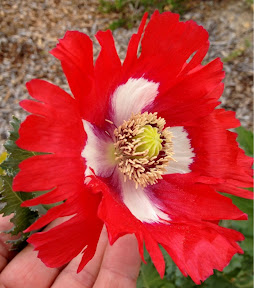
Papaver 'Danebrog', finally

I had a brief and satisfying email exchange with Annie's Annuals. After reviewing a picture that I sent they agreed that they had sent the wrong Papaver selection and offered a gift card in the amount of my purchase. Of the three blooms I've seen (one of four plants has yet to bloom) two were 'Queen's Poppy' and one was the selection I'd ordered, 'Danebrog', shown below with its characteristic ruffled petal edge. Danebrog means Danish flag, which the poppy resembles.


- Posted at great expense from my iPhone