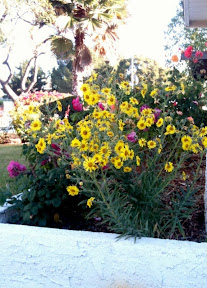
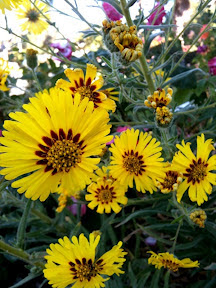
My mimulus (mimuli?) is doing what it should be doing - looking brown, but with a core of green. Barbara wrote something similar about a mimulus in the South Pasadena Nature Park, though hers is browner since it's both hotter and drier over there. I killed one a while back that was in a pot, but these are in planters and I'm watching them carefully so as not to apply too much water. I've applied a bit of water this summer, but I think we're in the home stretch and I'll be very sparing until the weather is much cooler. If I were more dedicated I'd pull off the browned flowers, since that appears to be about half the total brown. I have high hopes that they will look great this spring.
What looks like a near certain casualty is a Giant Chain Fern (now renamed Giant Chain Burn) that I planted in a pot near the front door. I thought it would be more shielded from the sun than it was. It ended up with several hours of bright direct and reflected light. Too much. The Yerba Buena in the same container is doing comparatively well, however. I'll need to propagate some of that around the yard and find an upright grower to replace the GCF.
2012-09-12
2012-08-27
Summer snooze coming to an end
There's been an excess of hot weather here that has now mercifully come to a close. My garden has suffered, since I've been focused elsewhere. I'm regretting the slowdown, but for some years now I've felt that like a many California native plants I only come awake in the fall. The blog has suffered too - I found two nearly month old comments that I felt shamed for not noticing before. I thought I was using Google's smart comment filtering and that most would be approved automatically. Apparently not.
The end of summer is always presaged by a regular event: Fall plant sales! An onslaught of advertisements arrive in my inbox for California native plant sales. First in this year was High Country Gardens, which told me that I needed to buy my seed ASAP for fall planting. Then one from The Payne Foundation - I didn't read it closely, but it might have been their regular monthly emailing. Annies Annuals hit my inbox too - again a monthly mailing I think. I like looking at their garden beauty shots. Tree of Life nursery, Rancho Santa Ana Botanic Garden, and my local native plant group all have sales coming up. I recommend all of them, but I won't be able to go to more than a few, so I'll pick and choose carefully.
From Connie Vadheim Roth came the most informative of the emails - a list of local sales dates, carefully compiled with links. She has posted the same information at Mother Nature's Backyard blog, but it's not immediately obvious where to click. Click here for the Fall Plant Sale list on MNBB. I've replicated the list below, mostly so that I can look at it.
The end of summer is always presaged by a regular event: Fall plant sales! An onslaught of advertisements arrive in my inbox for California native plant sales. First in this year was High Country Gardens, which told me that I needed to buy my seed ASAP for fall planting. Then one from The Payne Foundation - I didn't read it closely, but it might have been their regular monthly emailing. Annies Annuals hit my inbox too - again a monthly mailing I think. I like looking at their garden beauty shots. Tree of Life nursery, Rancho Santa Ana Botanic Garden, and my local native plant group all have sales coming up. I recommend all of them, but I won't be able to go to more than a few, so I'll pick and choose carefully.
From Connie Vadheim Roth came the most informative of the emails - a list of local sales dates, carefully compiled with links. She has posted the same information at Mother Nature's Backyard blog, but it's not immediately obvious where to click. Click here for the Fall Plant Sale list on MNBB. I've replicated the list below, mostly so that I can look at it.
2012-07-18
Glow worms!
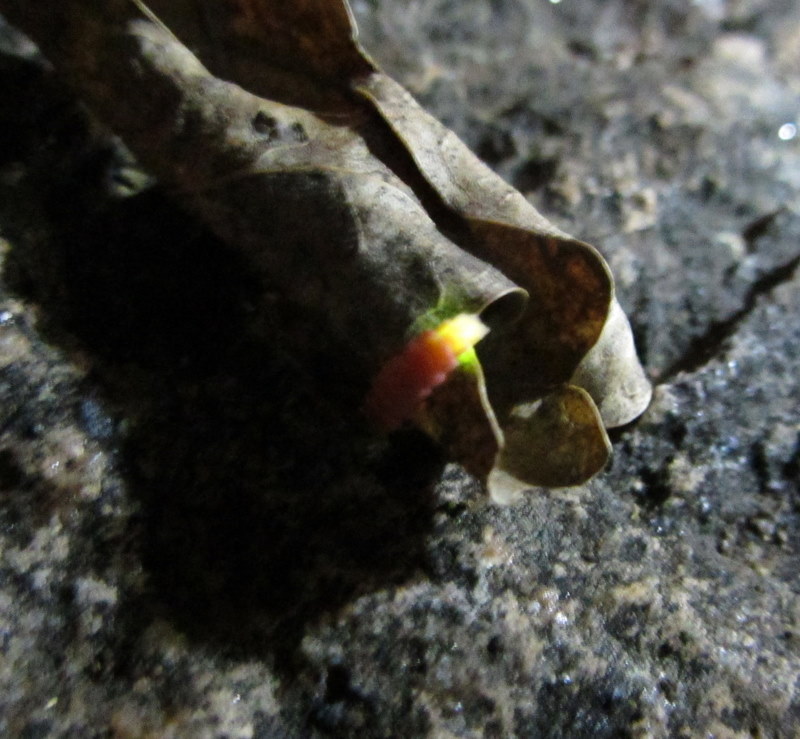
I spent a delightful week in the local mountains leading a generally well-behaved group of Scouts at Camp Tahquitz. One of the Scouts noticed a spot of light near the trail as we hiked back from a campfire in the dark (ah, the virtues of hiking in the dark!). It turns out that they are glow worms (a beetle), most likely California Pink Glowworms (Microphotus angustus)! I was so pleased to find this cousin of the firefly that I hadn't even dreamed of, and right in our back yard.
A little bit of online searching turned up many better photographs than mine as well as more authoritative information. It's hard to believe that that the food habits of this creature are still unknown: What an opportunity for a budding biologist. What I recall from the reading I did is that the glowing ones are actually mature females. The males fly about and don't glow, even though they are still called glow worms.
2012-07-16
Stylomecon redux
Long ago I posted about Wind Poppies (Stylonecon genus) and how I would update my reader on how they had done in the garden. Finally, the answer you have been waiting for is, pretty well.
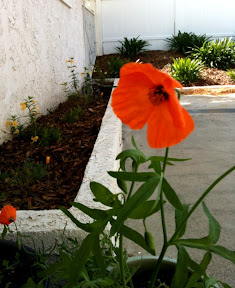
Here's one in the foreground with newly planted mimulus and California poppy (coastal variety, which I recommend whole heartedly over the inland variety) in the background.

Stylomecon in pots seemed to fare better, but I have only small number statistics. I think it due to the tailored drainage and water that I could give them in pots.

They seem to need quite well drained soil, so I'd guess that most garden beds are too moist. The flowers are prolific and bright, however they attach to the ground with a fragile tap root that can easily break.
I liked this plant and collected seeds for next year. Hopefully I can get it together and turn my California bland garden into a California grand garden.
- Posted at great expense from my iPhone
Here's one in the foreground with newly planted mimulus and California poppy (coastal variety, which I recommend whole heartedly over the inland variety) in the background.

Stylomecon in pots seemed to fare better, but I have only small number statistics. I think it due to the tailored drainage and water that I could give them in pots.

They seem to need quite well drained soil, so I'd guess that most garden beds are too moist. The flowers are prolific and bright, however they attach to the ground with a fragile tap root that can easily break.
I liked this plant and collected seeds for next year. Hopefully I can get it together and turn my California bland garden into a California grand garden.
- Posted at great expense from my iPhone
2012-07-15
Giant hill of Agapathus to California native plant haven?
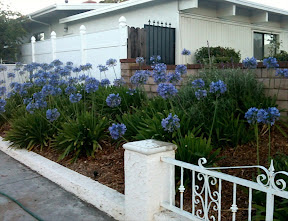
Check out the bloom on the Agapanthus along the driveway's edge.

Saul, my gardener, convinced me that I could coppice the Agapanthus and it would come back stronger than ever. He was right.
Wood chip mulch, made from trees cut from the property, covers the ground in between the aggies. They've served their purpose and kept me in the good graces of the neighborhood for the past 11 months.
But wait, what's that peeping out of those strappy leaves?

Why it's our old friend Cercis occidentalis (Western Redbud) which I planted as 1 gal babies not too long ago. They've grown so fast! There's three of them, harbingers of the end of the Agapanthus and the start of something better.
- Posted at great expense from my iPhone

Saul, my gardener, convinced me that I could coppice the Agapanthus and it would come back stronger than ever. He was right.
Wood chip mulch, made from trees cut from the property, covers the ground in between the aggies. They've served their purpose and kept me in the good graces of the neighborhood for the past 11 months.
But wait, what's that peeping out of those strappy leaves?

Why it's our old friend Cercis occidentalis (Western Redbud) which I planted as 1 gal babies not too long ago. They've grown so fast! There's three of them, harbingers of the end of the Agapanthus and the start of something better.
- Posted at great expense from my iPhone
2012-07-14
Unnatural restraint
I found a real garden planning triumph here.
Maybe I too should plant a Mexican Sage too close to the sidewalk (on a slope, no less), forget to cut it back, then prune it awkwardly and tie it like a bundle of firewood with a string that's bound to break in a couple months.

- Posted at great expense from my iPhone
Maybe I too should plant a Mexican Sage too close to the sidewalk (on a slope, no less), forget to cut it back, then prune it awkwardly and tie it like a bundle of firewood with a string that's bound to break in a couple months.

- Posted at great expense from my iPhone
Elysian Park to DTLA
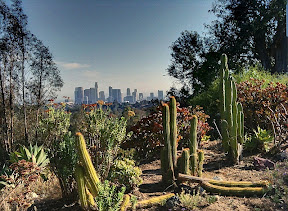
I had a nice stair walk with my buddy Dan. This was one of the sights along the way - neighbors have planted similar impromptu gardens all along this road above Elysian Park.

- Posted at great expense from my iPhone

- Posted at great expense from my iPhone
2012-06-30
Rodent barriers
Proving that poor aesthetics have no boundaries, this apparent rodent barrier doubles as a solar cooker on sunny days.

Seriously, what was this guy thinking? There's no particular reason for rodents to be in this tree and it's not near his house. And what's with the double row of circular concrete pavers? They look like manhole covers.

- Posted at great expense from my iPhone

Seriously, what was this guy thinking? There's no particular reason for rodents to be in this tree and it's not near his house. And what's with the double row of circular concrete pavers? They look like manhole covers.

- Posted at great expense from my iPhone
Madia elegans ii
The Madia elegans (Tarweed) is blooming nicely. It's in the Asteraceae family and the seeds were used as food by native people.
This was a "try one to see if you like it and it likes you" sort of garden effort, so I tucked it into the corner of the rose bed in front.

The photo above was taken in the a.m., when the flowers seem to seek light. They are fully open and the look of the plant is quite nice.

But by the end of the day, the flowers shun the more direct sunlight that the plant receives on the western side of my house. Some seem to close entirely and others pivot away from the sun. This is a known behavior of the plant.
- Posted at great expense from my iPhone
This was a "try one to see if you like it and it likes you" sort of garden effort, so I tucked it into the corner of the rose bed in front.

The photo above was taken in the a.m., when the flowers seem to seek light. They are fully open and the look of the plant is quite nice.

But by the end of the day, the flowers shun the more direct sunlight that the plant receives on the western side of my house. Some seem to close entirely and others pivot away from the sun. This is a known behavior of the plant.
- Posted at great expense from my iPhone
2012-06-08
Madia elegans (Common Madia)
It's started to flower now, and looks to be coming on strong with many more flowers. Red roses in the background sort of set the scale and lets you know that these flowers are significantly larger than your garden variety daisy.
This is, of course, a California native plant, but not exclusively: It is endemic to the western states. One of the common names is Tar Weed, because it has a strong and distinctive smell, unlike tar if you ask me, but strong and distinctive nonetheless. This was a one-off purchase / experiment from Annies and it's done quite well.
![]() |
| Madia elegans (Common Madia, Tar Weed) |
This is, of course, a California native plant, but not exclusively: It is endemic to the western states. One of the common names is Tar Weed, because it has a strong and distinctive smell, unlike tar if you ask me, but strong and distinctive nonetheless. This was a one-off purchase / experiment from Annies and it's done quite well.
2012-06-01
Don't do this
It's so much easier to be a critic than to be a force for knowledge and goodness. Plus it's fun to point out others' mistakes while revealing none of your own. In that spirit, I offer two things you should strive NEVER to do in the garden.
First up is crappy topiary that looks like tuna cans then we talk about dangerous and strangely shaped trees.
2012-05-21
Point Vicente lighthouse
I stopped by the lighthouse on the way home. I hadn't been before, and there's a delightful native plant garden and "wild" area adjacent on the bluff tops.

The best scenery is out towards the ocean, however.

Up at the inland edge of the "wild" area there's a wooden rail fence. On the right is the wild area. On the left is some developer's or homeowners' association idea of compatible plantings. This photo has Agapanthus and sprinkler irrigation. Indian Hawthorne, sheared to a fare-thee-well and Fortnight Lily adorn the irrigated hell strip adjacent the road. If only they had used smarter choices.

Don't do this.
- Posted at great expense from my iPhone

The best scenery is out towards the ocean, however.

Up at the inland edge of the "wild" area there's a wooden rail fence. On the right is the wild area. On the left is some developer's or homeowners' association idea of compatible plantings. This photo has Agapanthus and sprinkler irrigation. Indian Hawthorne, sheared to a fare-thee-well and Fortnight Lily adorn the irrigated hell strip adjacent the road. If only they had used smarter choices.

Don't do this.
- Posted at great expense from my iPhone
2012-05-08
A low-functioning ecosystem - Western Ave hillside at Dodson
I had emailed my local CNPS Chapter Vice President, David Sundstrom, a couple weeks ago about some Broom plants growing above Western on the untended hillside. I was hoping that he could call out the troops to eradicate the Broom. There's little of it on the peninsula, so keeping it out is a lot easier than trying to remove it once it's got it's hooks in. (Added 09 May: I used the What's Invasive web interface to add Broom to the list of invasive plants on the Palos Verdes Peninsula. It's there in a combined Genista / Cytisus spp category. I believe this Broom is French Broom, Genista monspessulana, based on the hairy pods, though I didn't take close enough observations to be certain.)
Since we live in a relatively affluent community, there must be City resources to do this job, no doubt supported by an annual gala fundraiser, right? Not so much. David and I were the "troops" and we met for about two hours on Sunday to demo the Broom. My childhood spent doing yard work stood me in good stead this day as I wielded lobbers with samurai-like precision cutting the plants to the ground. One plant appeared to be the mother ship, as David called it, and he had to take that on with a saw - the trunk was maybe 4-5 inches in diameter. Most others were amenable to the loppers. Seed pods for this year were not deemed viable yet, so we mulched the plant material in place. However, there were signs of multiple years of growth on some plants with last season's dried seed husks still on them. I guess we're due for a few years of return trips to knock down the sibling plants. Our cooler coastal climate is probably not ideal for Broom. I would guess it likes the hotter and more inland foothill and mountain ranges more, so perhaps the plants have been held in check by local climate conditions.
These snails of unusual color were on many Broom plants and on the mustard as well.
Since we live in a relatively affluent community, there must be City resources to do this job, no doubt supported by an annual gala fundraiser, right? Not so much. David and I were the "troops" and we met for about two hours on Sunday to demo the Broom. My childhood spent doing yard work stood me in good stead this day as I wielded lobbers with samurai-like precision cutting the plants to the ground. One plant appeared to be the mother ship, as David called it, and he had to take that on with a saw - the trunk was maybe 4-5 inches in diameter. Most others were amenable to the loppers. Seed pods for this year were not deemed viable yet, so we mulched the plant material in place. However, there were signs of multiple years of growth on some plants with last season's dried seed husks still on them. I guess we're due for a few years of return trips to knock down the sibling plants. Our cooler coastal climate is probably not ideal for Broom. I would guess it likes the hotter and more inland foothill and mountain ranges more, so perhaps the plants have been held in check by local climate conditions.
These snails of unusual color were on many Broom plants and on the mustard as well.
A functioning ecosystem - Backbone Trail to Circle X Ranch
I had the great pleasure to lead a group of Scouts on a backpacking trip in the Malibu mountains last weekend. We hiked a segment of the Back Bone Trail, a trail that is nearly a complete 65 mile run from Will Rogers State Historic Park to Point Mugu. I was a bit outwardly focused, especially when starting the trip, and forgot my good camera. I still had my trusty cell phone camera, however. What I saw was a beautiful and functioning ecosystem. I saw flowering lupines, blue eyed grass, mimulus, and salvia species and much more. Lots of pictures below:
Subscribe to:
Posts (Atom)