I've always had an affinity for Wyethia species, perhaps because they seem so unobtainable in the trade. Wyethia or Mule's Ears comes in a number of different flavors and these ones appear to be Wyethia mollis or Wooly Mule's Ears, seen on a hike in the Sierra near Pinecrest on June 18th, 2012. Unfortunately, I've never managed to see a whole field in bloom before in person, but I think the texture and leaf hues are interesting in their own right.
Holy mules ears, Batman:
2012-09-18
2012-09-17
Seed inventory
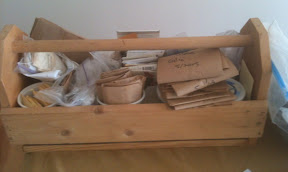
How do others store and organize their seeds? I keep mine in stored in this wooden tool carrier:

Everything from fava beans to Datura is stored together, mostly in paper bags but also (frequently enough that it bothers me) in plastic bags. I'm not likely to change my system. I'm a seed saver as well as a purchaser znd I'm reasonably attentive to labeling type, date, and origin of seeds I collect.
Now is the perfect time to go through the collection of native plant seeds and figure out how many more I need to get this year.
- Posted at great expense from my iPhone

Everything from fava beans to Datura is stored together, mostly in paper bags but also (frequently enough that it bothers me) in plastic bags. I'm not likely to change my system. I'm a seed saver as well as a purchaser znd I'm reasonably attentive to labeling type, date, and origin of seeds I collect.
Now is the perfect time to go through the collection of native plant seeds and figure out how many more I need to get this year.
- Posted at great expense from my iPhone
2012-09-14
2012-09-13
With a rubble wall
I had popular songs from the 80s running through my head the other day, one of which I thought apropos of my wall building activities. You mean it's "rebel yell" not "rubble wall"? Ah well, I always preferred his earlier efforts.
I've had a much slower start than I wanted on gardening projects at the new house. I've been there 13 months and I got stymied pretty much at month 2 in an incident that I may go into later. There's been some benefit to this, however. Since I've been living with the garden in an unremediated state I've had ample opportunity to prioritize and let the best ideas percolate to the top of my brain while dropping the overly ambitious, too costly, unfocused, or otherwise flawed ideas. Here's the first significant garden project that has percolated to the top through its urgency due to the coming winter rains and its conceptual simplicity - being less grandiose and more practical than, for example, replacing my front lawn.
There is a drainage problem in my side yard where several fruit trees are planted. This is a south-facing yard, but with the fence and neighbor's house providing shade, it's not unbearably bright and there seems to be ample reflected light for vegetables as well as the usual native plant suspects. However, the existing fruit trees aren't doing as well as one might hope, in part due to the fact that they are planted a slope between the neighbor's house and mine and you can't irrigate them, particularly with the existing shrub sprayers, without instantly getting abundant run off.
Here's what it looked like when I first moved in. My house is at left and we're looking through the front gate to the back gate. There's three types of citrus (one of which produced last year - yummy mandarins, but none produced this year), peach (no eatable production, though raccoons or possums got a few), apricot (no production, ever), and pomegranate (the best producer and very tasty too).
Note the dry-stacked bricks actually set onto on the pathway. Don't do this. The previous owner must have put them there in a vain attempt to retain water and soil soil that runs down the hill. Copious agapanthus is a landscaping hallmark of the previous owner, somewhat reduced today and destined for great reduction.
Compounding the water issues are that the neighbor's paved side yard can only drain to my property, a small pitch of my roof drains to this same side yard onto the concrete walkway (visible at the far end of the path in the above photo), and that same paved walkway has been raised by roots which makes water pond against the side of my house. None of these are good, but the solution is straightforward: terrace the hill area and install a retaining wall to decrease the slope and allow water to percolate in. Widen the walk area to include space for soil drainage, break out and re-set the concrete to slope it away from my house, and direct roof drainage onto pervious surfaces where it will seep in. Simple, right?
I needed to get started by removing the ineffective irrigation lines placed along the bottom of the slope where I will soon install a wooden retaining wall. I was always in fear of breaking off the sprayers with a casual misstep as I worked in the yard or even walked in the dark down the path. Plus, spraying up the hill with these old style shrub sprinklers was always such a pain and the run off was so copious that I never did it for fear of the waste. There's inexpensive shrub sprinkler retrofits available now that use much less water and apply it much more evenly. I decided the irrigation could go at the top of the hill and I'd irrigate downward, salvaging and reusing the old irrigation with upgraded sprinkler heads - I tried a Toro Matched Precipitation Rate (MPR) sprinkler head, which seems like one of the smarter new designs. MP Rotator seems to be the Cadillac of new designs. Oh, along the way I discovered not one but two defunct galvanized irrigation lines that I felt I needed to rip out. Since they ran the length of the side yard, there's a lot of galvanized to recycle.
I pulled out the PVC line, made some minor repairs, rerouted the incoming water line, and buried it in a shallow grave^H^H^H^H^Htrench near the top of the slope. I don't know if this was a bad choice or not, but I decided that for ease of future repair or replacement the shallow trench could be covered by the rock rubble that I would use for the narrow top tier of my terrace. I find rock aplenty on this property whenever I dig. Below, the shallow trench and rock rubble poised to make my retaining wall.
Natives can go out of harm's way and mostly out of the irrigation on the narrow upper tier. With a rubble wall like this I was going for a look that was rustic and of this place, since this type of rock (Catalina Schist) is commonly found in my area and is widely used as building materials.
There's not much to it, when its all installed (below).
Next step: Build a redwood retaining wall at the bottom of the slope and figure out something to do with the bricks (there's not enough to build a retaining wall). As a last resort, they are easy to give away on Craigslist.
I've had a much slower start than I wanted on gardening projects at the new house. I've been there 13 months and I got stymied pretty much at month 2 in an incident that I may go into later. There's been some benefit to this, however. Since I've been living with the garden in an unremediated state I've had ample opportunity to prioritize and let the best ideas percolate to the top of my brain while dropping the overly ambitious, too costly, unfocused, or otherwise flawed ideas. Here's the first significant garden project that has percolated to the top through its urgency due to the coming winter rains and its conceptual simplicity - being less grandiose and more practical than, for example, replacing my front lawn.
There is a drainage problem in my side yard where several fruit trees are planted. This is a south-facing yard, but with the fence and neighbor's house providing shade, it's not unbearably bright and there seems to be ample reflected light for vegetables as well as the usual native plant suspects. However, the existing fruit trees aren't doing as well as one might hope, in part due to the fact that they are planted a slope between the neighbor's house and mine and you can't irrigate them, particularly with the existing shrub sprayers, without instantly getting abundant run off.
Here's what it looked like when I first moved in. My house is at left and we're looking through the front gate to the back gate. There's three types of citrus (one of which produced last year - yummy mandarins, but none produced this year), peach (no eatable production, though raccoons or possums got a few), apricot (no production, ever), and pomegranate (the best producer and very tasty too).
Note the dry-stacked bricks actually set onto on the pathway. Don't do this. The previous owner must have put them there in a vain attempt to retain water and soil soil that runs down the hill. Copious agapanthus is a landscaping hallmark of the previous owner, somewhat reduced today and destined for great reduction.
Compounding the water issues are that the neighbor's paved side yard can only drain to my property, a small pitch of my roof drains to this same side yard onto the concrete walkway (visible at the far end of the path in the above photo), and that same paved walkway has been raised by roots which makes water pond against the side of my house. None of these are good, but the solution is straightforward: terrace the hill area and install a retaining wall to decrease the slope and allow water to percolate in. Widen the walk area to include space for soil drainage, break out and re-set the concrete to slope it away from my house, and direct roof drainage onto pervious surfaces where it will seep in. Simple, right?
I needed to get started by removing the ineffective irrigation lines placed along the bottom of the slope where I will soon install a wooden retaining wall. I was always in fear of breaking off the sprayers with a casual misstep as I worked in the yard or even walked in the dark down the path. Plus, spraying up the hill with these old style shrub sprinklers was always such a pain and the run off was so copious that I never did it for fear of the waste. There's inexpensive shrub sprinkler retrofits available now that use much less water and apply it much more evenly. I decided the irrigation could go at the top of the hill and I'd irrigate downward, salvaging and reusing the old irrigation with upgraded sprinkler heads - I tried a Toro Matched Precipitation Rate (MPR) sprinkler head, which seems like one of the smarter new designs. MP Rotator seems to be the Cadillac of new designs. Oh, along the way I discovered not one but two defunct galvanized irrigation lines that I felt I needed to rip out. Since they ran the length of the side yard, there's a lot of galvanized to recycle.
I pulled out the PVC line, made some minor repairs, rerouted the incoming water line, and buried it in a shallow grave^H^H^H^H^Htrench near the top of the slope. I don't know if this was a bad choice or not, but I decided that for ease of future repair or replacement the shallow trench could be covered by the rock rubble that I would use for the narrow top tier of my terrace. I find rock aplenty on this property whenever I dig. Below, the shallow trench and rock rubble poised to make my retaining wall.
Natives can go out of harm's way and mostly out of the irrigation on the narrow upper tier. With a rubble wall like this I was going for a look that was rustic and of this place, since this type of rock (Catalina Schist) is commonly found in my area and is widely used as building materials.
There's not much to it, when its all installed (below).
2012-09-12
Return of Fall!
We've had a long heat wave, but all signs are that it will break soon, and just in time for fall, my favorite season. Fall officially starts on Sept 22 this year, the date of the autumnal equinox when there are 12 hours of daylight and 12 hours of night. However, today while driving over the top of Palos Verdes I encountered dense fog, to the point that I turned on the fog lights, slowed down, and made sure I was in my proper lane and had made the correct turns.
Wikipedia says that "According to United States tradition, autumn runs from the day after Labor Day (i.e. the Tuesday following the first Monday of September) through Thanksgiving (i.e. the fourth Thursday in November), after which the holiday season that demarcates the unofficial beginning of winter begins." But I say that fall arrives when you can feel it in the air and see it in the plants. A look at the long term weather forecast shows higher than normal temperatures even at the 10-day mark, but now I can feel the beginnings of fall and it felt great!
Heat wave casualty
My mimulus (mimuli?) is doing what it should be doing - looking brown, but with a core of green. Barbara wrote something similar about a mimulus in the South Pasadena Nature Park, though hers is browner since it's both hotter and drier over there. I killed one a while back that was in a pot, but these are in planters and I'm watching them carefully so as not to apply too much water. I've applied a bit of water this summer, but I think we're in the home stretch and I'll be very sparing until the weather is much cooler. If I were more dedicated I'd pull off the browned flowers, since that appears to be about half the total brown. I have high hopes that they will look great this spring.
What looks like a near certain casualty is a Giant Chain Fern (now renamed Giant Chain Burn) that I planted in a pot near the front door. I thought it would be more shielded from the sun than it was. It ended up with several hours of bright direct and reflected light. Too much. The Yerba Buena in the same container is doing comparatively well, however. I'll need to propagate some of that around the yard and find an upright grower to replace the GCF.
2012-08-27
Summer snooze coming to an end
There's been an excess of hot weather here that has now mercifully come to a close. My garden has suffered, since I've been focused elsewhere. I'm regretting the slowdown, but for some years now I've felt that like a many California native plants I only come awake in the fall. The blog has suffered too - I found two nearly month old comments that I felt shamed for not noticing before. I thought I was using Google's smart comment filtering and that most would be approved automatically. Apparently not.
The end of summer is always presaged by a regular event: Fall plant sales! An onslaught of advertisements arrive in my inbox for California native plant sales. First in this year was High Country Gardens, which told me that I needed to buy my seed ASAP for fall planting. Then one from The Payne Foundation - I didn't read it closely, but it might have been their regular monthly emailing. Annies Annuals hit my inbox too - again a monthly mailing I think. I like looking at their garden beauty shots. Tree of Life nursery, Rancho Santa Ana Botanic Garden, and my local native plant group all have sales coming up. I recommend all of them, but I won't be able to go to more than a few, so I'll pick and choose carefully.
From Connie Vadheim Roth came the most informative of the emails - a list of local sales dates, carefully compiled with links. She has posted the same information at Mother Nature's Backyard blog, but it's not immediately obvious where to click. Click here for the Fall Plant Sale list on MNBB. I've replicated the list below, mostly so that I can look at it.
The end of summer is always presaged by a regular event: Fall plant sales! An onslaught of advertisements arrive in my inbox for California native plant sales. First in this year was High Country Gardens, which told me that I needed to buy my seed ASAP for fall planting. Then one from The Payne Foundation - I didn't read it closely, but it might have been their regular monthly emailing. Annies Annuals hit my inbox too - again a monthly mailing I think. I like looking at their garden beauty shots. Tree of Life nursery, Rancho Santa Ana Botanic Garden, and my local native plant group all have sales coming up. I recommend all of them, but I won't be able to go to more than a few, so I'll pick and choose carefully.
From Connie Vadheim Roth came the most informative of the emails - a list of local sales dates, carefully compiled with links. She has posted the same information at Mother Nature's Backyard blog, but it's not immediately obvious where to click. Click here for the Fall Plant Sale list on MNBB. I've replicated the list below, mostly so that I can look at it.
2012-07-18
Glow worms!
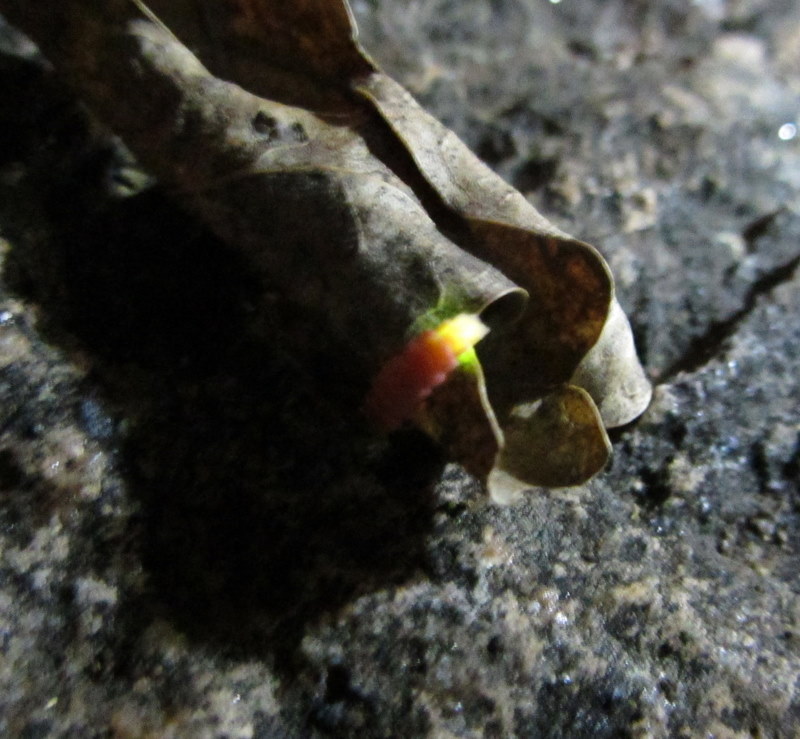
I spent a delightful week in the local mountains leading a generally well-behaved group of Scouts at Camp Tahquitz. One of the Scouts noticed a spot of light near the trail as we hiked back from a campfire in the dark (ah, the virtues of hiking in the dark!). It turns out that they are glow worms (a beetle), most likely California Pink Glowworms (Microphotus angustus)! I was so pleased to find this cousin of the firefly that I hadn't even dreamed of, and right in our back yard.
A little bit of online searching turned up many better photographs than mine as well as more authoritative information. It's hard to believe that that the food habits of this creature are still unknown: What an opportunity for a budding biologist. What I recall from the reading I did is that the glowing ones are actually mature females. The males fly about and don't glow, even though they are still called glow worms.
2012-07-16
Stylomecon redux
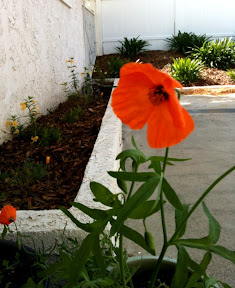
Long ago I posted about Wind Poppies (Stylonecon genus) and how I would update my reader on how they had done in the garden. Finally, the answer you have been waiting for is, pretty well.
Here's one in the foreground with newly planted mimulus and California poppy (coastal variety, which I recommend whole heartedly over the inland variety) in the background.

Stylomecon in pots seemed to fare better, but I have only small number statistics. I think it due to the tailored drainage and water that I could give them in pots.

They seem to need quite well drained soil, so I'd guess that most garden beds are too moist. The flowers are prolific and bright, however they attach to the ground with a fragile tap root that can easily break.
I liked this plant and collected seeds for next year. Hopefully I can get it together and turn my California bland garden into a California grand garden.
- Posted at great expense from my iPhone
Here's one in the foreground with newly planted mimulus and California poppy (coastal variety, which I recommend whole heartedly over the inland variety) in the background.

Stylomecon in pots seemed to fare better, but I have only small number statistics. I think it due to the tailored drainage and water that I could give them in pots.

They seem to need quite well drained soil, so I'd guess that most garden beds are too moist. The flowers are prolific and bright, however they attach to the ground with a fragile tap root that can easily break.
I liked this plant and collected seeds for next year. Hopefully I can get it together and turn my California bland garden into a California grand garden.
- Posted at great expense from my iPhone
2012-07-15
Giant hill of Agapathus to California native plant haven?
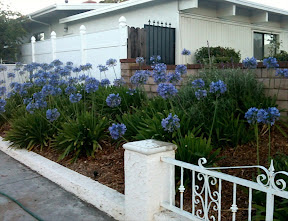
Check out the bloom on the Agapanthus along the driveway's edge.

Saul, my gardener, convinced me that I could coppice the Agapanthus and it would come back stronger than ever. He was right.
Wood chip mulch, made from trees cut from the property, covers the ground in between the aggies. They've served their purpose and kept me in the good graces of the neighborhood for the past 11 months.
But wait, what's that peeping out of those strappy leaves?

Why it's our old friend Cercis occidentalis (Western Redbud) which I planted as 1 gal babies not too long ago. They've grown so fast! There's three of them, harbingers of the end of the Agapanthus and the start of something better.
- Posted at great expense from my iPhone

Saul, my gardener, convinced me that I could coppice the Agapanthus and it would come back stronger than ever. He was right.
Wood chip mulch, made from trees cut from the property, covers the ground in between the aggies. They've served their purpose and kept me in the good graces of the neighborhood for the past 11 months.
But wait, what's that peeping out of those strappy leaves?

Why it's our old friend Cercis occidentalis (Western Redbud) which I planted as 1 gal babies not too long ago. They've grown so fast! There's three of them, harbingers of the end of the Agapanthus and the start of something better.
- Posted at great expense from my iPhone
2012-07-14
Unnatural restraint
I found a real garden planning triumph here.
Maybe I too should plant a Mexican Sage too close to the sidewalk (on a slope, no less), forget to cut it back, then prune it awkwardly and tie it like a bundle of firewood with a string that's bound to break in a couple months.

- Posted at great expense from my iPhone
Maybe I too should plant a Mexican Sage too close to the sidewalk (on a slope, no less), forget to cut it back, then prune it awkwardly and tie it like a bundle of firewood with a string that's bound to break in a couple months.

- Posted at great expense from my iPhone
Elysian Park to DTLA
I had a nice stair walk with my buddy Dan. This was one of the sights along the way - neighbors have planted similar impromptu gardens all along this road above Elysian Park.

- Posted at great expense from my iPhone

- Posted at great expense from my iPhone
2012-06-30
Rodent barriers
Proving that poor aesthetics have no boundaries, this apparent rodent barrier doubles as a solar cooker on sunny days.

Seriously, what was this guy thinking? There's no particular reason for rodents to be in this tree and it's not near his house. And what's with the double row of circular concrete pavers? They look like manhole covers.

- Posted at great expense from my iPhone

Seriously, what was this guy thinking? There's no particular reason for rodents to be in this tree and it's not near his house. And what's with the double row of circular concrete pavers? They look like manhole covers.

- Posted at great expense from my iPhone
Madia elegans ii
The Madia elegans (Tarweed) is blooming nicely. It's in the Asteraceae family and the seeds were used as food by native people.
This was a "try one to see if you like it and it likes you" sort of garden effort, so I tucked it into the corner of the rose bed in front.

The photo above was taken in the a.m., when the flowers seem to seek light. They are fully open and the look of the plant is quite nice.

But by the end of the day, the flowers shun the more direct sunlight that the plant receives on the western side of my house. Some seem to close entirely and others pivot away from the sun. This is a known behavior of the plant.
- Posted at great expense from my iPhone
This was a "try one to see if you like it and it likes you" sort of garden effort, so I tucked it into the corner of the rose bed in front.

The photo above was taken in the a.m., when the flowers seem to seek light. They are fully open and the look of the plant is quite nice.

But by the end of the day, the flowers shun the more direct sunlight that the plant receives on the western side of my house. Some seem to close entirely and others pivot away from the sun. This is a known behavior of the plant.
- Posted at great expense from my iPhone
Subscribe to:
Comments (Atom)