
2013-03-01
Spring is upon us!
Winter seems to be over. Southern California can still get remarkable rain through March, but the plants aren't waiting around for it.
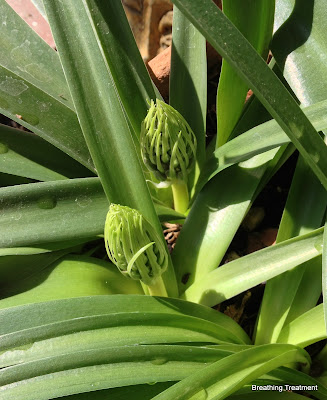
Here's a (non-native) bulb that my neighbor Carol gave to me years ago. I've mistreated it ever since, appreciating only the brief splash of strappy green leaves. This year with my focus on native bulbs it got some spill over attention and look at what showed up! We'll be keeping tabs on those blooms.


2013-02-20
Rain 0.25"; season total 5.76"
Though I enjoyed the dry Presidents' Day weekend for a nice backpacking trip to Willett Hot Springs, I was happy to finally see a bit of rain.

Rainfall was intense for a brief period and left us with 0.25" inches.
20 Feb 2013 0.25"; 5.76" total.
I'm glad I didn't have to cross the Sespe River (above) right after the rain. Could have been hazardous.

Rainfall was intense for a brief period and left us with 0.25" inches.
20 Feb 2013 0.25"; 5.76" total.
I'm glad I didn't have to cross the Sespe River (above) right after the rain. Could have been hazardous.
2013-02-13
Rain 0.23"; season total 5.51"
With no substantial rain in sight through the coming weekend this is feeling like a low rain year, again.
0.22" 8 Feb 2013
0.01" 9 Feb 2013
- Posted at great expense from my iPhone
0.22" 8 Feb 2013
0.01" 9 Feb 2013
- Posted at great expense from my iPhone
2013-02-06
House Centipede
Recently I've seen these little guys in the side yard. However the first time I saw one it had found its way inside.

- Posted at great expense from my iPhone
- Posted at great expense from my iPhone
2013-02-05
Lupine and Solidago
3 Feb, 2012
I gathered some lupine seed from plants by the side of the road last year. They were growing within walking distance, and based on seeing other lupines around the area I'm guessing that they are a local native. Feeling like a thief I gathered them in the dark and before many were fully ripened. Fortunately I acted when I did because the little wide spot in the road was cut to the ground a week or so later. This winter I scattered the seed in a small area in my back yard and I have two lupine sprouts that have shown their heads.
 This was two out of perhaps tens of seeds, but given the condition of the seed that's probably OK.
Looking nicer by the day is Solidago californica (California Goldenrod). This came from Annies and I think I planted it in near ideal conditions. It's supposed to flower from late summer to fall, so why is it flowering now? It's been my experience that sometimes the first year a nursery-grown plant is installed it is off its timing somewhat. I attribute this to the change from nursery conditions to garden conditions.

I gathered some lupine seed from plants by the side of the road last year. They were growing within walking distance, and based on seeing other lupines around the area I'm guessing that they are a local native. Feeling like a thief I gathered them in the dark and before many were fully ripened. Fortunately I acted when I did because the little wide spot in the road was cut to the ground a week or so later. This winter I scattered the seed in a small area in my back yard and I have two lupine sprouts that have shown their heads.
Looking nicer by the day is Solidago californica (California Goldenrod). This came from Annies and I think I planted it in near ideal conditions. It's supposed to flower from late summer to fall, so why is it flowering now? It's been my experience that sometimes the first year a nursery-grown plant is installed it is off its timing somewhat. I attribute this to the change from nursery conditions to garden conditions.
2013-02-03
Shopping trip
I went on a little shopping trip today. This was the view at my destination.

Recognize it?
It's the Santa Barbara Botanic Garden meadow. Nearly everyone takes a photo of it when they visit - for good reason.
I didn't have scenery on the mind. I was shopping.
They had Iris 'Canyon Snow', and I succumbed to the following in 4" pots: Giant coreopsis (been wanting one for years), Argemone munita (a thistle with a flower that resembles a fried egg aka
Prickly Poppies, Thistle Poppy, Chicalote, or Cowboy's Fried Egg), and Heuchera 'Canyon Delight' (Canyon Delight Coral Bells), and an Umbellularia californica (California Bay tree) which I will keep in a pot.
- Posted at great expense from my iPhone
Recognize it?
It's the Santa Barbara Botanic Garden meadow. Nearly everyone takes a photo of it when they visit - for good reason.
I didn't have scenery on the mind. I was shopping.
They had Iris 'Canyon Snow', and I succumbed to the following in 4" pots: Giant coreopsis (been wanting one for years), Argemone munita (a thistle with a flower that resembles a fried egg aka
Prickly Poppies, Thistle Poppy, Chicalote, or Cowboy's Fried Egg), and Heuchera 'Canyon Delight' (Canyon Delight Coral Bells), and an Umbellularia californica (California Bay tree) which I will keep in a pot.
- Posted at great expense from my iPhone
2013-02-02
Garden status
The garden is greening up with recent rains. Here's a brief selection.
 | |
| Chlorogalum pomeridianum (Soaproot) and Solidago californica (California Goldenrod) in background. |
 |
| Western Wallflower. There's three and the best and worst performing are shown here. |
 |
| Cirsium occidentale "Cobweb Thistle". The best of the three I have planted. |
 |
| Asclepias sprouting out. Weed at right got pulled. |
2013-02-01
Bulbs!
I got started a bit late in the bulb game this year. I read about the real bulb fanatics (mostly tulip and other exotic plant fanciers) who plan their acquisitions like a military campaign and scour the bulb catalogs for new and untried varieties that will scratch their itch, but I got my overwhelming bulb interest a bit late for planning. It was a bit of a gathering storm: At first I had a fantasy vision of a hillside of saffron so I went
big with Crocus sativus, Saffron Crocus - 70 bulbs in all! C. Sativus is not native to California, but it is a Mediterranean plant with a fascinating history and of course it has well known culinary uses. Needless to
say, my eyes were bigger than my actual ability to finish a hillside project in time to plant these. This turned out OK, however, since Juli became the recipient of many which I put in a trough planter at her house.
The ones I planted at my house are also in a rectangular trough and in numerous smaller circular planters.
I had the idea that I would give the small circular planters as Christmas gifts, but that idea, like many others,
fell through when I got a bit busy. I'll bet Crocus makes a nice Easter
present, along with that can I kicked down the road.
Thinking about C. sativus re-stimulated my interest in native bulbs. I have enduring memories of coming across Lilium, Brodiaea, and Calochortus species while hiking. They seem so unexpectedly beautiful to me. Why couldn't I have some of that in my yard?
I thought I could scratch my itch with Allium unifolium (One-leaf Onion, which is mostly grown as an ornamental rather than a food plant) and I already had gathered seed at my previous house. A. unifolium is also available as a bulb, but I think that you can't really call yourself a gardener if you don't start plants from seed occasionally. Plus there's no added cost with seed you gather yourself (beyond the hundreds of dollars you'll spend in time and energy monitoring your plant babies). I soon learned why it's somewhat uncommon for most gardeners to start bulbs from seed: Allium can take up to a year or two to sprout, particularly if the seed is old. Even if you sprout the first year, there's usually a whole year of waiting while the first bulbs develop. Sure enough, as of 1/22 I'd only sprouted a weed. Allium seed that could sit around doing nothing for a year or more didn't satisfy me for long, and so the saga of late season bulb acquisition began in which I tried to get all sorts of bulbs with that urgent sense of desperation that comes from knowing that I'd miss a whole year of growing if I didn't get it done RIGHT NOW. Consequently, planning went out
the window into high gear and nearly all of the bulbs ended up in
planters rather than the garden. They'll do fine in the planters and in many cases that's where they may stay.
Two Chlorogalum pomeridianum (Soap Root), did make it into the yard where they are sprouting nicely - it looks like my gardener took the top off of one of them (background in photo below and not shown), but it seems otherwise healthy. I saw these in abundance hiking in the Malibu mountains, a possible ethonobotanic remnant of the native people who lived there once and used them as soap, for food, and a host of other uses.
In rapid order came Calochortus venustus (Butterfly Mariposa Lily) (not shown).
Then came Tritelia that Juli had been nursing in a pot at her house. With her benign neglect it had multiplied, but she did not want to give any up since she liked them so much. I replanted them in a larger pot at her house. They are flourishing with occasional added water. (also not shown)
I also managed to put my mitts on Bloomeria crocea (aka Golden Stars -Two short pots at left) and Calochortus catalinea ( Catalina mariposa lily - Two pale turquoise and one small basic clay pot at right) quite late in the season thanks to Tony Baker at Natural Landscapes. The other pots contain C. Sativus (7 small circular pots in mostly metallic colors), an unnamed Roger's Red offspring (far left, also from Tony Baker), and Mirabilis californica (California four o'clock, wishbone bush - square pot at left). Allium is in the tallest basic clay pot with gravel mulch (top center).
The bulbs are sometimes only subtly different at this stage.
The ones I planted at my house are also in a rectangular trough and in numerous smaller circular planters.
 |
| C. sativus (Saffron Crocus) in foreground. Calochortus venustus (Butterfly Mariposa Lily) is in far circular pot. |
Thinking about C. sativus re-stimulated my interest in native bulbs. I have enduring memories of coming across Lilium, Brodiaea, and Calochortus species while hiking. They seem so unexpectedly beautiful to me. Why couldn't I have some of that in my yard?
I thought I could scratch my itch with Allium unifolium (One-leaf Onion, which is mostly grown as an ornamental rather than a food plant) and I already had gathered seed at my previous house. A. unifolium is also available as a bulb, but I think that you can't really call yourself a gardener if you don't start plants from seed occasionally. Plus there's no added cost with seed you gather yourself (beyond the hundreds of dollars you'll spend in time and energy monitoring your plant babies). I soon learned why it's somewhat uncommon for most gardeners to start bulbs from seed: Allium can take up to a year or two to sprout, particularly if the seed is old. Even if you sprout the first year, there's usually a whole year of waiting while the first bulbs develop. Sure enough, as of 1/22 I'd only sprouted a weed. Allium seed that could sit around doing nothing for a year or more didn't satisfy me for long, and so the saga of late season bulb acquisition began in which I tried to get all sorts of bulbs with that urgent sense of desperation that comes from knowing that I'd miss a whole year of growing if I didn't get it done RIGHT NOW. Consequently, planning went
Two Chlorogalum pomeridianum (Soap Root), did make it into the yard where they are sprouting nicely - it looks like my gardener took the top off of one of them (background in photo below and not shown), but it seems otherwise healthy. I saw these in abundance hiking in the Malibu mountains, a possible ethonobotanic remnant of the native people who lived there once and used them as soap, for food, and a host of other uses.
 |
| Chlorogalum pomeridianum (Soap Root) (foreground and background). My homemade mulch is rather coarse but I think it's distinctive looking. At right is a little bit of Zauschneria / Epilobium (California Fuschia) |
In rapid order came Calochortus venustus (Butterfly Mariposa Lily) (not shown).
Then came Tritelia that Juli had been nursing in a pot at her house. With her benign neglect it had multiplied, but she did not want to give any up since she liked them so much. I replanted them in a larger pot at her house. They are flourishing with occasional added water. (also not shown)
 |
| Some of my newly planted bulbs. Smaller circular pots containing Crocus sativus were intended as gifts but didn't quite make it. Coming to a gift giving holiday near you soon! |
I also managed to put my mitts on Bloomeria crocea (aka Golden Stars -Two short pots at left) and Calochortus catalinea ( Catalina mariposa lily - Two pale turquoise and one small basic clay pot at right) quite late in the season thanks to Tony Baker at Natural Landscapes. The other pots contain C. Sativus (7 small circular pots in mostly metallic colors), an unnamed Roger's Red offspring (far left, also from Tony Baker), and Mirabilis californica (California four o'clock, wishbone bush - square pot at left). Allium is in the tallest basic clay pot with gravel mulch (top center).
The bulbs are sometimes only subtly different at this stage.
 |
| Calochortus venustus (Butterfly Mariposa Lily). One of these has a different look. |
 |
| This Calochortus venustus (Butterfly Mariposa Lily) has different leaf texture and shape than its siblings. |
 |
| Calochortus catalinea (Catalina mariposa lily). Leaf size and color has slight differences from Calochortus venustus. Growth habit seems a bit more upright. |
2013-01-31

2013-01-29
Rain 2.27"; season total 5.28"
We've had a couple rain storms that left about an inch of rain, one in December and one last week. That's a nice amount of rain for us, distributed over a comfortable amount of time. My native plants are loving the cool and wet soil and hopefully setting their roots for summer.
1.12" rain 25 Jan. The San Pedro Annex had 0.5". I tend to measure more rain than the Annex, a 10 minute drive and at least one Sunset garden zone away.
0.25" 26 Jan
0.09" 27 Jan
- Posted at great expense from my iPhone
1.12" rain 25 Jan. The San Pedro Annex had 0.5". I tend to measure more rain than the Annex, a 10 minute drive and at least one Sunset garden zone away.
0.25" 26 Jan
0.09" 27 Jan
- Posted at great expense from my iPhone
2013-01-12
Green walls at Charles de Gaulle
I didn't get a chance to do more than snap a photo as I walked by, neither one of which is all that great. There were several of these were in the immense Gate M area.


- Posted at great expense from my iPhone
- Posted at great expense from my iPhone
2013-01-11
Recent rains; Season total 3.82"
14 Dec 2012 0.08"
15 Dec 2012 0.02"
16 Dec 2012 0.09"
17 Dec 2012 0.05"
18 Dec 2012 0.29"
19 Dec 2012 0.22"
28 Dec 2012 0.95" upon my return from vacation. Probably more since I'm told the rain came soon after the 19th.
06 Jan 2013 0.06"
10 Jan 2013 0.01" not actually measured - ground wet and v. minor puddles
Weather.com will display recorded precipitation if you select the monthly display, howver, I find that they are often quite different than what I record. A brief search for confirming rainfall data on the web seemed to show that while wind speed and temperature were measured at 10 local weather stations (some private and some government run) not one reported rainfall. It's hard to believe that this is true, so I will assume I'm looking in the wrong place. The alternative is that rainfall reports are extrapolated from widely dispersed ground gauges or from radar images. This seems a poor way to do business since rainfall can vary widely from my side of the hill (leeward of the ocean) to points only a short distance away (facing the ocean or on the flats).
- Posted at great expense from my iPhone
15 Dec 2012 0.02"
16 Dec 2012 0.09"
17 Dec 2012 0.05"
18 Dec 2012 0.29"
19 Dec 2012 0.22"
28 Dec 2012 0.95" upon my return from vacation. Probably more since I'm told the rain came soon after the 19th.
06 Jan 2013 0.06"
10 Jan 2013 0.01" not actually measured - ground wet and v. minor puddles
Weather.com will display recorded precipitation if you select the monthly display, howver, I find that they are often quite different than what I record. A brief search for confirming rainfall data on the web seemed to show that while wind speed and temperature were measured at 10 local weather stations (some private and some government run) not one reported rainfall. It's hard to believe that this is true, so I will assume I'm looking in the wrong place. The alternative is that rainfall reports are extrapolated from widely dispersed ground gauges or from radar images. This seems a poor way to do business since rainfall can vary widely from my side of the hill (leeward of the ocean) to points only a short distance away (facing the ocean or on the flats).
- Posted at great expense from my iPhone
Large Toyon
This is one of the larger Toyons I've seen. It and some others of similar stature are located nearby in Peck Park. Maximum height by width given on the Payne Foundation website is 15'x15'. Las Pilitas says up to 20' tall if it's a happy plant. This seems at least 30' tall.

Don't be confused because there's only berries on the lower branches - the Toyon has a tree-like stature in this photo.

- Posted at great expense from my iPhone
Don't be confused because there's only berries on the lower branches - the Toyon has a tree-like stature in this photo.
- Posted at great expense from my iPhone
2013-01-10

Subscribe to:
Posts (Atom)