I got this link to "17,000 Species in the Great Smoky Mountains. And Counting" (http://www.metropulse.com/news/2011/nov/16/17000-species-great-smoky-mountains-and-counting/) from my native plant listserv courtesy of Jeffrey Caldwell, along with an interesting observation from that report:
“...most of the plant species that you see in the Great Smoky Mountains National Park rely on ants to disperse their seeds,” Sanders says. “So one of the things we did was just put out seeds and look at what happened to them. And 166 out of 167 times, one ant species carried the seed away. So even though there there’s a lot of biodiversity in the Smokies, there’s some species that do a lot.” If one of those super-species was threatened by changes in its habitat, it could have wide-ranging consequences.
Most native plant fanciers appreciate the role of insects in the food web, but the role of ants was previously unknown to me. I seem to recall that a native (and distinctly larger) black ant was more plentiful when I was growing up, but I have hardly seen them recently. I think they've been supplanted by Argentine ants all along the western coast of the US.
2011-11-17


2011-11-09
Native plant detective story - Aesculus californica
I was leaning against the bar in a speakeasy in Malaga Cove, waiting for Juli to finish her Christmas shopping, when a girl got up from the table where she had been sitting with three other people and came over to me. She was small and blonde, and whether you looked at her face or at her body in powder-blue sport clothes, the result was satisfactory. "Aren't you Brent?" she asked.
I said: "Yes."
She held out her hand. "I'm Dorothy Aesculus. You don't remember me, but you ought to remember my father, Bucky Aesculus. You-"
"Sure," I said, "and I remember you now, but you were only a kid of eleven or twelve then, weren't you?"
"Yes, that was eight years ago. Listen: remember those stories you told me? Were they true?"
"Probably not. How is your father?"
She laughed. "I was going to ask you. Mamma divorced him, you know, and we haven't heard from him since 2005. Don't you ever see him?"
My glass was empty. I asked her what she would have to drink, she said Scotch and soda. I ordered two of them and said: "No, I've been driving and hiking all around, but I haven't seen him."
She said slowly: "I'd like to see him. Mamma would raise hell if she found it out, but I'd like to see him."
"I would too. And?"
"He's not in the phone book or city directory."
"Try his lawyer," I suggested.
Her face brightened. "Who is he?"
"It used to be a fellow named Jep-something-or-other-Jepson, that's it, Jepson Herbarium. He was in the Singer Building."
"Lend me a nickel," she said, and went out to the telephone.*
Well, it wasn't as dramatic as all that.
One of the fun things about a new garden is the time you spend before you plant, planning the whole thing. Gardening is work and you expect to break a sweat doing it. But in the planning stages you can live in a sort of Platonic ideal of a garden - filled with possibilities and not one drop yet of sweat.
I was spending some time considering the merits of California Buckeye (Aesculus californica) as a yard tree and went looking for data supporting its presence on the Palos Verdes Peninsula. It's a signature tree of my summer travels to northern California and I like it a lot. Aesculus is one of the hallmarks of my summer travels with great looking new foliage, followed by 6 inch or longer flower spikes, and a distinctive early browning of leaf color before it loses them all.
However, I was regretful that I hadn't noted any in my travels around my neighborhood. They are distinctive trees. A few idle minutes with my underworld informants told me that there was information to be had in the Jepson Herbarium. Sure enough, an occurrence was noted near Malaga Cove, but there was only one reported sighting from 2005 that noted only two trees, so anything could have happened in the intervening years! Were they the last ones? I got a little excited about rediscovering what seems to be a rarely occurring native tree in Palos Verdes. Maybe there was no trace left? Maybe there was only one or none left! The thrill of the hunt is similar to that of geocaching, except that the trees I was looking for could be well hidden or even extirpated.
 Hot on their trail, this morning I went on a little walk and found what I think were two spindly looking, multi-trunked, Aesculus. I saw no dried flower spikes or fruits which would have made identification easier, possibly due to the poor health of the trees. However, I had also expected either bare branches or completely brown foliage at this time of year based on what I know of the tree in N. California. What I found were leaves still on the tree with a color that I'd expect to see no later than mid summer in hotter inland N. California areas. See the photo of a typical leaf that I found on the ground nearby. The local climate is much cooler in summer and warmer in winter than N. California, so perhaps that explains the late autumn colors. Otherwise, it seems to match to Aesculus Californica. I've emailed some local experts for more info.
Are these are in fact PV-native or transplants? Truly local plants will probably have genetic variations that are specific to their regional microclimate. Are there other stands of Aesculus elsewhere on the Peninsula? Seems like there's a sequel in the making.
*Stolen without regret from Dashiell Hammett's The Thin Man
2011-11-05
Rain 0.20"; season total 1.42"
We had rain again last night of 0.20". I had regretted not having my rain gauge out in the yard for the first storm of the season in early October, but I found an old dog bowl in my back yard after that storm and measured the water in it to to get a handle on that storm's rain: 1.22 inches! Based on the location of the dog bowl (out in the clear) I think it was a true reading even though 1.22" seems like a lot of rain. I'll go with it for now as the official first rainfall of the season at my new home and feel good about having a complete record for this season.
The San Pedro annex, only 10 minutes by car away, received 0.35" of rain to my 0.20".
The San Pedro annex, only 10 minutes by car away, received 0.35" of rain to my 0.20".
2011-10-26
Local trails and busy but not forgotten
I'm busy doing some things other than blogging. One of the fun things I'm doing is familiarizing myself with local trails. It turns out there are plenty of obscure and undocumented ones, such as the "Mailbox Trail" which quickly devolves into a single track along the edge of George F Canyon.
 George F turns into another canyon system further along, and the trails are wide and well maintained in this area (for horses).
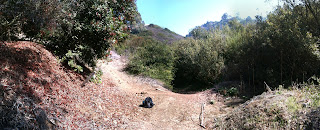
That's Toyon (Heteromeles arbutifolia) on the left with the red berries and Lemonade Berry (Rhus integrifolia) looming over the right hand branch of the trail. They're easy to tell apart this time of year with the red berries only on Toyon, which is also known as Christmas Berry. When they are not in bloom, I think the easiest way to tell them apart is by the leaf edges: Serrations on the Toyon, smooth or wavy on Lemonade Berry. This seems to be locally true, anyway.
I have been assured that all trails are public access, yet already I've run into what appear to be bogus trail closings promulgated by local homeowner groups (thinks to self, "Hmm. I don't see the advertised trail hazard that motivated trail closure with not one but two chain link fences across the trail. Curious - these fences seem designed to cut off down-trail access into a gated community that is advertised as open at the public-access trailhead. Wow, even the horsemen passing within eyeshot of the trail closure don't seem to think there's a hazard.")
I sense some advocacy in my future. Until then, I'm just a quiet trails anthropologist and I'll keep a photo record documenting trail conditions without trying to perturb the system.
I'll be back in a bit to tell you more about native plants - I have tremendous plans for my new yard. Until then, I'm a bit busy. See you on the trails.


That's Toyon (Heteromeles arbutifolia) on the left with the red berries and Lemonade Berry (Rhus integrifolia) looming over the right hand branch of the trail. They're easy to tell apart this time of year with the red berries only on Toyon, which is also known as Christmas Berry. When they are not in bloom, I think the easiest way to tell them apart is by the leaf edges: Serrations on the Toyon, smooth or wavy on Lemonade Berry. This seems to be locally true, anyway.
I have been assured that all trails are public access, yet already I've run into what appear to be bogus trail closings promulgated by local homeowner groups (thinks to self, "Hmm. I don't see the advertised trail hazard that motivated trail closure with not one but two chain link fences across the trail. Curious - these fences seem designed to cut off down-trail access into a gated community that is advertised as open at the public-access trailhead. Wow, even the horsemen passing within eyeshot of the trail closure don't seem to think there's a hazard.")
I sense some advocacy in my future. Until then, I'm just a quiet trails anthropologist and I'll keep a photo record documenting trail conditions without trying to perturb the system.
I'll be back in a bit to tell you more about native plants - I have tremendous plans for my new yard. Until then, I'm a bit busy. See you on the trails.
2011-10-14
Charlotte to Charlie to Charles to Chuck
There were several if these large spiders around the house a couple weeks ago. They were at my old house too until they mysteriously disappeared - I think the neighbor sprayed.
This one started as a relatively petite Charlotte and ended as thuggish Chuck over a couple week period of time.
The camera angle makes it appear that there's a large blurry spider on my lawn, but it's really just 50 cent piece sized spider in the foreground of the shot.

- Posted at great expense from my iPhone
This one started as a relatively petite Charlotte and ended as thuggish Chuck over a couple week period of time.
The camera angle makes it appear that there's a large blurry spider on my lawn, but it's really just 50 cent piece sized spider in the foreground of the shot.
- Posted at great expense from my iPhone
2011-10-05
First rains of the winter
I'm happy that we're getting some rain. Often it will rain in October and then be dry again until much later in the year, so an early start on the winter rains isn't necessarily a harbinger of a wet winter. Traffic was typically slow yesterday morning and this morning due to our first rain of the year: We had a small amount of rain yesterday A.M. and more today that appears to be making more of a lasting impression.
My new house is in a rain "shadow" on the east side of a coastal hill. As I drive around the hill on which I live each morning, I've noticed that my east facing, leeward, side of the hill seems to consistently have less moisture than the ocean side. This seems an intuitive result for storms arriving from the ocean and it's also true for fog, which can be a significant contributor to soil moisture.
Sadly, my rain gauge is not out in the yard yet so I'll have to make an educated guess on the precipitation from this storm. I would have liked to start the winter with some solid measurements.
Addendum: I found an old dog bowl in the yard with 3.1 cm of water in it, so I'm going with rainfall of 1.22". That's a lot!
My new house is in a rain "shadow" on the east side of a coastal hill. As I drive around the hill on which I live each morning, I've noticed that my east facing, leeward, side of the hill seems to consistently have less moisture than the ocean side. This seems an intuitive result for storms arriving from the ocean and it's also true for fog, which can be a significant contributor to soil moisture.
Sadly, my rain gauge is not out in the yard yet so I'll have to make an educated guess on the precipitation from this storm. I would have liked to start the winter with some solid measurements.
Addendum: I found an old dog bowl in the yard with 3.1 cm of water in it, so I'm going with rainfall of 1.22". That's a lot!
2011-10-01

2011-09-13
Out of the Box: California native plants for hedges
Joan Bolton of Santa Barbara writes a nice blog about gardening and garden design. A recent blog post called Splendid Hedges has recommendations for California native plant hedges. Joan recommends Lemonade berry (Rhus integrifolia), Hollyleaf cherry (Prunus ilicifolia), Catalina cherry (Prunus lyonii), Ceanothus 'Julia Phelps', Toyon (Heteromeles arbutifolia), Howard McMinn manzanita (Arctostaphylos densiflora ‘Howard McMinn’) and Oregon grape (Berberis aquifolium) as hedges.
I guess that most people think big when they think of hedges, even though the ~1 foot tall clipped box (Buxus) hedges used as borders and in European knot gardens are equally hedges in my mind. Here's a nice photo that I found at Boxtrees Nursery (in England of course).

Maybe there's no smallish California native plant that lends itself to that style of hedge since the smallest pruned and maintained size among the plants that Joan recommends are the last two, which she says can be maintained at 6 feet tall and 4 feet wide. Or maybe with our high population density we're really talking about privacy and screening views when we in California talk about hedges. I looked briefly online for examples of California natives in a tightly sheared hedge, but didn't find any pictures. I do recall pruning a Lemonade Berry hedge with loppers and an electric clipper at a friend's house in Hope Ranch when I was a teen.
Scanning the archives of my (northern California based) listserve I came up with these suggestions for hedge plants:
Rhus integrifolia (the previously mentioned Lemonade Berry)
Galvesia speciosa (some selections will grow with a more compact habit than others)
Bacharris pilularis (Coyote Bush)
Garry elliptica 'Evie' or 'James Roof' or even the straight species
Rhamnus crocea can be used as a very formal hedge
Ribes viburnifolium (Evergreen Currant)
Cercocarpus betuloides (Mountain Mahogany)
Garrya elliptica
Arctostaphylos 'Sunset' was recommended instead of McMinn as it was said to be more hedge-like and not require much in the way of pruning
Coffeeberry
Las Pilitas nursery, always a source of interesting information, has a section on hedges and screens. They include some more iconoclastic selections.
Finally, in a related blog post earlier, Naked behind a screen in the garden, KarenH suggested that I look at a Los Angeles area online native plant resource called Project SOUND, which I have mentioned very occasionally here. It's nice to see that it's up and running and thank you KarenH.
I guess that most people think big when they think of hedges, even though the ~1 foot tall clipped box (Buxus) hedges used as borders and in European knot gardens are equally hedges in my mind. Here's a nice photo that I found at Boxtrees Nursery (in England of course).
Maybe there's no smallish California native plant that lends itself to that style of hedge since the smallest pruned and maintained size among the plants that Joan recommends are the last two, which she says can be maintained at 6 feet tall and 4 feet wide. Or maybe with our high population density we're really talking about privacy and screening views when we in California talk about hedges. I looked briefly online for examples of California natives in a tightly sheared hedge, but didn't find any pictures. I do recall pruning a Lemonade Berry hedge with loppers and an electric clipper at a friend's house in Hope Ranch when I was a teen.
Scanning the archives of my (northern California based) listserve I came up with these suggestions for hedge plants:
Rhus integrifolia (the previously mentioned Lemonade Berry)
Galvesia speciosa (some selections will grow with a more compact habit than others)
Bacharris pilularis (Coyote Bush)
Garry elliptica 'Evie' or 'James Roof' or even the straight species
Rhamnus crocea can be used as a very formal hedge
Ribes viburnifolium (Evergreen Currant)
Cercocarpus betuloides (Mountain Mahogany)
Garrya elliptica
Arctostaphylos 'Sunset' was recommended instead of McMinn as it was said to be more hedge-like and not require much in the way of pruning
Coffeeberry
Las Pilitas nursery, always a source of interesting information, has a section on hedges and screens. They include some more iconoclastic selections.
Finally, in a related blog post earlier, Naked behind a screen in the garden, KarenH suggested that I look at a Los Angeles area online native plant resource called Project SOUND, which I have mentioned very occasionally here. It's nice to see that it's up and running and thank you KarenH.
2011-09-08
Garden miscellany
Here's an interesting garden juxtaposition. To set the stage: This photo was taken at the LA County Museum of Art. The permanent garden that lines the walkways between buildings has a high level of LA-style design: Bright red painted steel uprights for the walkway roof, exceptionally straight and perfectly aligned COR-TEN steel retaining walls, COR-TEN steel raised planters that resemble wooden planter boxes, and a range of imported plants starting with turf grass and ending with palms.
Surrounding the BCAM building and LACMA's courtyard is a 100 palm tree garden, designed by artist Robert Irwin and landscape architect Paul Comstock. Some of the 30 varieties of palms are in the ground, but most are in large wooden boxes above ground. - Wikipedia (but of course those wooden boxes are actually steel that resembles wood boxes, so Wikipedia is wrong in that small matter. Also the palms are not all, strictly speaking, palms.)
Given the high level of design and the mix of imported plant materials I thought that this reindeer (clearly made from artificial plant materials, surmounting a "bark" hill that is dotted with plastic flowers, and surrounded by a synthetic box hedge) was a sly comment on the permanent garden. Alas, it is a marker for the entrance to the Tim Burton exhibit and destined to move on when the exhibit closes on Oct 31. The reindeer was a prop in the movie Edward Scissorhands.

Tim Burton has a fairly prolific career so there was ample material but when it was all said and done I was left feeling like I'd had a Dodger Dog and a large Coke instead of a five course gourmet meal.
Here's another "garden" looking north from the end of the Palos Verdes peninsula. I believe that's Rhus integrifolia (Lemonade Berry) in the foreground. I saw a large Mimulus on the cliffs as well in full late summer dormancy.

Surrounding the BCAM building and LACMA's courtyard is a 100 palm tree garden, designed by artist Robert Irwin and landscape architect Paul Comstock. Some of the 30 varieties of palms are in the ground, but most are in large wooden boxes above ground. - Wikipedia (but of course those wooden boxes are actually steel that resembles wood boxes, so Wikipedia is wrong in that small matter. Also the palms are not all, strictly speaking, palms.)
Given the high level of design and the mix of imported plant materials I thought that this reindeer (clearly made from artificial plant materials, surmounting a "bark" hill that is dotted with plastic flowers, and surrounded by a synthetic box hedge) was a sly comment on the permanent garden. Alas, it is a marker for the entrance to the Tim Burton exhibit and destined to move on when the exhibit closes on Oct 31. The reindeer was a prop in the movie Edward Scissorhands.

Tim Burton has a fairly prolific career so there was ample material but when it was all said and done I was left feeling like I'd had a Dodger Dog and a large Coke instead of a five course gourmet meal.
Here's another "garden" looking north from the end of the Palos Verdes peninsula. I believe that's Rhus integrifolia (Lemonade Berry) in the foreground. I saw a large Mimulus on the cliffs as well in full late summer dormancy.

Landscape Resource
I just found what looks to be a useful online plant palette design tool associated with a website called Landscape Resource. It has an obvious URL (http://www.landscaperesource.com/) that I can't actually make an active link since I'm bound by the site's overly broad terms and conditions which state in part,
8. You may not create a link to this website from another website or document without Landscape Resource's prior written consent.
Maybe I'm the only one who reads those things. I emailed them and had a speedy and friendly reply from Rob Maday who told me that he agreed and that the Terms and Conditions were under review.
The site looks promising enough that you should check it out. Hopefully, you'll someday soon be able to refer traffic directly to their site.
8. You may not create a link to this website from another website or document without Landscape Resource's prior written consent.
Maybe I'm the only one who reads those things. I emailed them and had a speedy and friendly reply from Rob Maday who told me that he agreed and that the Terms and Conditions were under review.
The site looks promising enough that you should check it out. Hopefully, you'll someday soon be able to refer traffic directly to their site.
2011-09-05
World's largest and most florific Cal. Poppy

That's one California Poppy (Eschlozia californica maritima) plant overwhelming a downhill rose. I posted on this poppy earlier in May! of this year and it's amazing that it's still producing blooms.
- Posted at great expense from my iPhone
2011-09-01
Naked behind a screen in the garden
I stumbled across a good article about Naked Ladies the other day - Amaryllis belladonna, not Playmates. The author, Joan Bolton, comes from nearby Santa Barbara so her gardening know-how would appear to translate well to Los Angeles. Browsing her blog I quickly stumbled across some information that I thought would be more immediately useful in a post called Splendid Hedges. Recall that I just posted how I need to hide a neighbor's front yard with a hedge or screen.
Here's the naked view from my front yard this morning.
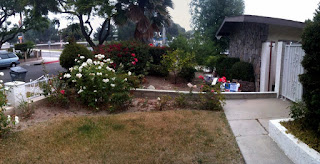

My property is slightly higher than the neighbor's and the scrawny roses currently planted along a low wall don't provide enough height to hide the garbage cans and piles of brick in the neighbor's yard. There's also no amount of planting that I can do where my walkway meets the retaining wall, and that's the area that I'd like to screen the most. On the one hand, I admire the neighbor for having the balls to buck the wall to wall green grass trend and plant an orchard instead. On the other hand, I don't want to look at their garbage can storage area.
For purposes of continuity, I briefly considered extending the fantastic (you'll have to imagine the sarcasm in my voice) Eugenia topiary into hedges or adding more Eugenia as a dedicated hedge, but after about a nanosecond I concluded that I was going to demo the incongruously-placed and uninteresting layer cake topiary. (A highly innovative stacked sphere topiary is visible at left in the above picture. Imagine many similar but purposeless topiary sentinels, like Easter Island statues. Ugh.) So, no Eugenia hedge for me.
I then spent a good long time thinking and reading about native plant hedge solutions, but it turns out that native hedge plants may not be the best solution. Most hedge plants tend to be taller and broader than I need or want and they don't address the gap where the concrete walkway abuts the retaining wall. But, while I thought I was thinking about hedges, my mind apparently was spinning up other ideas.
It turns out that there may be a partial hardscape solution: Extending the ornamental fence that already exists on the front side of my property might do the trick, provided I grow low arching shrubs in front or climbing plants on it. This would definitely be a harmonious solution that would take up the minimum of space. There may even be standard fence panels that are a bit taller than those I currently have that would give it a bit more screening. The picture below is a crude mockup of how it might work.

Extending an imaginary line from the top of the large white-flowered rose in that picture says that I would only need to overtop the fence by a foot to two feet to get all the screen that I wanted.
I haven't had a chance to closely observe it, but I think that the sun exposure in this area of my garden is partial - it's shaded by the Jacaranda street trees in the PM and by the house in the AM. Foggy days are likely too. This kind of exposure is consistent with the mixed success that the previous owners apparently had with roses in this area.
To cover the planting gap where the concrete meets the wall I'll want vines or arching growth that I can tie or train to the fence. This narrows the selection process nicely. This seems to be the short list:
Calystegia macrostegia (Morning Glory Vine). My locally native variety has small white flowers but the Channel Island selection "Anacapa Pink" has large pink veined flowers. Evergreen.
Clematis ligusticifolia (Virgin's Bower or Yerba De Chiva). Winter deciduous.
Lonicera hispidula (California or Pink Honeysuckle) - a vine-like shrub that has relatively sparse growth. Semi-evergreen.
Vitis 'Walker Ridge' (Walker Ridge Wild Grape). Smaller selection. Winter deciduous.
Put one of those on a small fence and I won't feel so naked any more.
Here's the naked view from my front yard this morning.


My property is slightly higher than the neighbor's and the scrawny roses currently planted along a low wall don't provide enough height to hide the garbage cans and piles of brick in the neighbor's yard. There's also no amount of planting that I can do where my walkway meets the retaining wall, and that's the area that I'd like to screen the most. On the one hand, I admire the neighbor for having the balls to buck the wall to wall green grass trend and plant an orchard instead. On the other hand, I don't want to look at their garbage can storage area.
For purposes of continuity, I briefly considered extending the fantastic (you'll have to imagine the sarcasm in my voice) Eugenia topiary into hedges or adding more Eugenia as a dedicated hedge, but after about a nanosecond I concluded that I was going to demo the incongruously-placed and uninteresting layer cake topiary. (A highly innovative stacked sphere topiary is visible at left in the above picture. Imagine many similar but purposeless topiary sentinels, like Easter Island statues. Ugh.) So, no Eugenia hedge for me.
I then spent a good long time thinking and reading about native plant hedge solutions, but it turns out that native hedge plants may not be the best solution. Most hedge plants tend to be taller and broader than I need or want and they don't address the gap where the concrete walkway abuts the retaining wall. But, while I thought I was thinking about hedges, my mind apparently was spinning up other ideas.
It turns out that there may be a partial hardscape solution: Extending the ornamental fence that already exists on the front side of my property might do the trick, provided I grow low arching shrubs in front or climbing plants on it. This would definitely be a harmonious solution that would take up the minimum of space. There may even be standard fence panels that are a bit taller than those I currently have that would give it a bit more screening. The picture below is a crude mockup of how it might work.

Extending an imaginary line from the top of the large white-flowered rose in that picture says that I would only need to overtop the fence by a foot to two feet to get all the screen that I wanted.
I haven't had a chance to closely observe it, but I think that the sun exposure in this area of my garden is partial - it's shaded by the Jacaranda street trees in the PM and by the house in the AM. Foggy days are likely too. This kind of exposure is consistent with the mixed success that the previous owners apparently had with roses in this area.
To cover the planting gap where the concrete meets the wall I'll want vines or arching growth that I can tie or train to the fence. This narrows the selection process nicely. This seems to be the short list:
Calystegia macrostegia (Morning Glory Vine). My locally native variety has small white flowers but the Channel Island selection "Anacapa Pink" has large pink veined flowers. Evergreen.
Clematis ligusticifolia (Virgin's Bower or Yerba De Chiva). Winter deciduous.
Lonicera hispidula (California or Pink Honeysuckle) - a vine-like shrub that has relatively sparse growth. Semi-evergreen.
Vitis 'Walker Ridge' (Walker Ridge Wild Grape). Smaller selection. Winter deciduous.
Put one of those on a small fence and I won't feel so naked any more.
2011-08-18
Can I compost my whole yard?
I'd love to unleash a giant mutant lawnmower / chipper / shredder robot on the whole yard, make a giant pile of compost*, and start fresh with the gardens. Doing something similar by hand is a daunting task; there's some exciting possibilities in my new gardens, but it will take some heavy demolition work to get to a useable state.
Some pictures:
Some pictures:
2011-08-12
Franciscan manzanita video
Back from the Brink: for the last wild franciscan manzanita
It has long been known that the Presidio is home to the last Raven's manzanita on earth. Surprisingly, a chance discovery made in 2010 during the Doyle Drive reconstruction project revealed the existence of the Franciscan manzanita, thought to have been extinct in the wild for more than 70 years. This 23-minute film by San Francisco filmmaker Melissa Peabody tells the compelling story of these two icons of California's natural heritage. Produced 2011. Presidio Trust.
It has long been known that the Presidio is home to the last Raven's manzanita on earth. Surprisingly, a chance discovery made in 2010 during the Doyle Drive reconstruction project revealed the existence of the Franciscan manzanita, thought to have been extinct in the wild for more than 70 years. This 23-minute film by San Francisco filmmaker Melissa Peabody tells the compelling story of these two icons of California's natural heritage. Produced 2011. Presidio Trust.
Subscribe to:
Posts (Atom)