2010-10-26

Dawn harvest


Looks like enough for paella?

- Posted at great expense from my iPhone

2010-10-25

Rain 0.28"; Season total 1.63"

0.08" on 23 Oct
0.20" on 25 Oct - nice overnight rain with beautiful blue skies on the morning of the 25!

A total of 0.28" in a couple days is the nice sort of rainfall that makes gardens grow.

We're in between rainfall totals from the previous 6 years at the same date: three were greater and three were less.  If direct comparison to historical LA averages are to be trusted, we're well above both mean and median rainfall for the end of October, so we're running a little wet early in the season.  Forecasters are predicting a dryer than normal winter, however, so it might be best to make hay while the sun shinesflowers while the rain falls.

Corn maize

I visited the corn maze at Pierce College this weekend with Juli, Houston, and Chris. The maze makes Pierce College more money per acre than any other crop that they raise, according to them.

They give you a map of the maze before you start and you're supposed to use a distinctive hole punch at each of several waypoints to track your progress. The maps they give out are on postcards, but in case you need extra help there's always the signs.


I've done one maze elsewhere without the benefit of a map and it's very hard once you are inside,

Ariel photographs of previous years can be found online. The designs change from year to year and from the air it's clear that the mazes very accurately replicate their design. This year's maze, map pictured above, is complete with large letters spelling out "save the farm". Unfortunately, by this time in the season there were many unauthorized shortcuts through the maze so next time we'll try to go earlier in the season. That was really the only disappointment - being in a large maze is fun. We even got to see some huitlacoche:


Huitlacoche is supposed to be a great delicacy, but I thought it looked rather ghoulishly in keeping with the season.

Pierce College gets spooky after 7 pm. Here's the entrance to the corn field of horror or somesuch.


You have to pass beneath the gargoyle to encounter masked, chainsaw wielding psychos. Corny, or not?


- Posted at great expense from my iPhone

2010-10-24

Saffron crocus!!

Crocus sativus.


These took three years to produce. I've had the narrow leaves show in previous years, but never the blooms. I tasted a stigma straight from one flower and it was good!

I don't know what was different about this year as opposed to previous, perhaps the mild summer didn't dry them as much - they are said to produce better with supplemental water.

Wikipedia has some advice: "Timing is the key: generous spring rains and drier summers are optimal. Rain immediately preceding flowering boosts saffron yields; rainy or cold weather during flowering spurs disease and low yields. "

And

"Harvests are by necessity a speedy affair: after blossoming at dawn, flowers quickly wilt as the day passes. All plants bloom within a window of one or two weeks."

Looks like I missed the first harvest except for that one stigma.

- Posted at great expense from my iPhone

2010-10-23

Ooze on, L.A. River, ooze on

I picked up Keith & Rusty McNeil's California Songbook last summer while in Columbia.


The songs all relate in some way to California history and I like that they give a brief bit of historical context along with each song.

One of the selling points was this song at the back called L.A. River. Keith and Rusty write that the original author is anonymous, but that the song was taught to them in the 1960s by Clabe Hangan.

Lyrics to L.A. River:

There’s a river, a windin’ river, flowin’ through our town.
And it’s not so very mighty, but it sure does get around,
How I long to sit and cool my feet on its sterile banks of gray concrete,
Ooze on, L.A. River, ooze on.
Well it’s not so very mighty, and it’s not so deep and wide,
But its current has a longing to stay at low, low tide,
And I thank the Lord that it’s not blood red, but a peaceful, cool, green
algae instead, Ooze on, L.A. River, ooze on.

Now when the thunder sounds like fury and the rain begins to fall,
I dream that the mighty crashing is that river’s fearless roar,
But the sound I hear is not a dream, it’s a motorcycle goin` upstream,
Ooze on, L.A. River, ooze on.
Well it hasn’t any whitecaps, and it hasn’t any iish,
To see it splash and ripple, it would be my fondest wish,
But it floats its load of sad debris from the mighty sewer to the mighty sea,
Ooze on, L.A. River, ooze on.


- Posted at great expense from my iPhone

2010-10-20

So that means the drought's over, right?

No.  Don't confuse weather with climate.

Rain 0.31"; season total 1.35"

A series of rainy days gave me the following precipitation in my back yard:

0.01" 16-17 Oct. We had gray skies and mist.  I saw drops in the rain gauge, but by the time I came back to read it, the waters had evaporated so I'm booking only 0.01".  It seems clear that rain is on the way.

0.25" 20 Oct. Rain all day Tuesday and continuing into Wednesday.

0.05" of rain on Wednesday

This is a grand total of 0.31" of rain for this storm.   No more storms are predicted in the five day forecast.

Ocean friendly garden landscaping class wrapup

A hands on workshop (HOW) will be held at a residence in Torrance to implement some of the techniques described in this class on Sat Oct 30th from 11 to 2.  Contact mcgilvraydoug at yawho (correct misspellings / format to email)  for the address and to register.  This household is participating in the Garden Assistance Program whereby successful applicants get assistance to have their gardens reworked into ocean friendly gardens.  The same residence will renovate their garden on November 26, 10-4, another chance to get some hands on experience. 

My motivation for attending the Ocean Friendly Garden Landscaping Class (OFG.org) last night was partly to take the temperature of the local sentiment for California friendly gardening and partly to update and refresh my own knowledge.  I will have the opportunity to install a new garden in the near future and I'd like to do it right from the start instead of learning on the job as have in my current garden.  (Gardens are forgiving of many mistakes, but fundamental ones about drainage, irrigation, and hardscape are harder to overcome.)  I came away with a few new tidbits of information, better clarity, and a renewed sense of enthusiasm for ocean friendly gardens. The class teachers came from West Basin Water District, The Surf Rider Foundation, and the Green Gardens Group (G3).  I heard Paul Herzog of the Surfrider Foundation not too long ago at a CNPS meeting where he gave an abbreviated presentation.  Last night he spoke only briefly which let me get a fresh spin on the information from Pamela of G3, an engaging speaker.

Between 25 and 30 people attended the 3 hour ocean friendly gardens workshop that was held last night in Lomita.  Nearly all seemed alert and engaged, so it seemed there were few reluctant spouses or skeptics.  It looked like they had reservations for more, but rain may have kept people at home.  Still, I consider the turnout significant in number - my intuition tells me that there's still interest in transforming sterile lawn into habitat.  The south bay is a small enough world that I knew one attendee from work - he said he was looking into changes that made sense for his home.  I would guess that level of interest is the target audience for this presentation and I think it worked effectively on that level.

A couple questions that came from the audience indicated a general interest in water issues:

How come we don't have rationing? (Carol Kwan of West Basin attempted an answer that ended with, "Well, some areas like Manhattan Beach have tiered water rates" (apparently Lomita doesn't have tiered rates or people were unfamiliar with the concept) but didn't address any real political or process blocks to rationing or more / more aggressive tiers.  I held back from my cynical comment that rationing is typically based on history of past use and that everyone in the room ought to be using plenty of water to make sure they don't get rationed too much in the future.  Paul had noted earlier that water rates are expected to rise overall, motivating people to change all on their own, so perhaps that's the best answer, though it wasn't directed at this question.)

How much water evaporates from the aqueducts that convey water to southern California? (No answer was given.)
 

They supplied a CD with class presentations and supplemental material as a free take away from the session, which was a good idea (the PDFs they supply have only low resolution images in a format suitable for notes, not for reuse in a briefing). This picture of our watershed comes from their packet and it's my favorite image of the evening.  If you can't  visualize the watershed from this picture then you must be blind.


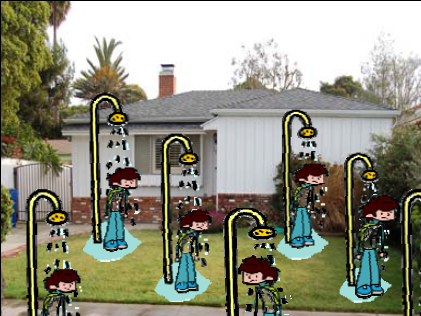
 My second favorite picture is this one:

It's meant to give you a metric for assessing the water usage of overhead sprinklers: each sprinkler head is similar to a shower in terms of its water use per unit time.  However I like it because I wouldn't mind showering outside (in the back yard, of course) in good weather.  No one mentioned outdoor showers as a good way to irrigate with gray water.  In fact, gray water didn't get any mention in the class - I wonder if Surfrider  is opposed to use of gray water or if that concept is too scary for the target audience of this class.


West Basin Water District provides support for a number of water use reduction activities and they seem to be pretty forward thinking in this regard.  They now have demonstration gardens in El Segundo and Carson(?) where they walk the walk.  Rebate programs continue with a new combined rebate program that allocates up to $235 per household for smart irrigation controllers.  bewaterwise.com was a constant referral for this type of information.

Some interesting tidbits from the class:

The widely quoted figure of 20% of electricity used in California is used for moving water was clarified - apparently it's used for moving and cleaning water.  I'm not sure how to verify this figure, but I'd like to.

143 gallons per person per day was the typical water use in LA (County) cited for a four person residence.   This includes outdoor water, which comprises a larger fraction of our total water use than use of our indoor water use.  This is in part due to our successful indoor conservation policies.  Nonetheless, something like 60% of all potable water used is used outdoors.

Soil testing - Why have I never done this?  Even though I'm a huge fan a data and I've been a successful gardener without it, think what a little more knowledge would do for me.  The simple mayonnaise jar test mixes soil with water to separate out the soil constituents and then maps the ratio of silt:sand:clay onto a ternary phase diagram to define soil type:
(image from http://bestlawn.info/the-news/70-soil-management.html)

The class didn't call this a ternary phase diagram, but of course I know one when I see it, so perhaps that common point of reference makes me more interested in this test.  Pamela recommended the use of distilled water for the test, but web references I checked don't require anything other than clean water.  She made a vague reference to "reactions" as the motivation for using DI water, but I can't think of reaction that could be of concern if just using tap water - buffering action by dissolved minerals shouldn't affect much of anything in the soils assessment.  If this procedure is also used to test soil pH, then of course DI water matters.

Another interesting aspect of the class was the focus on rain barrels and rain chains.  I've never been a fan of rain barrels, since they seem to have so little payback.  Pamela suggested that sequestering the first flush rainfall was most important in terms of providing environmental benefit and in that respect rain barrels could have a net positive impact, particularly in areas where rainfall can't be kept on property by other means.  Rain chains I've used before for their architectural benefit.  Pamela's focus was at times on water velocity - and the net positive impact of rain chains and barrels in that regard.  I don't think that rationale passes the sniff test for me.  She may have been meant to say rain flux or something else like that.  I'll have to explore this issue a little more later on.

All in all, this was a useful class, probably right on target for those not yet singing along with the choir.

2010-10-18

Encyclopedia Brown and the Case of the Infested Ceanothus

I have a generally healthy Ceanothus (California Lilac) along the back fence (species forgotten, but I think it's a popular garden selection, now 12' tall and doing a fine job of hiding the neighbor). I've given the garden a lot of neglect in the recent months but found some time to do general cleaning and tidying the other day. I noticed that there were many ants crawling into the Ceanothus and further investigation showed that one of the branches was covered in scale! The Argentinian ants will farm this parasite, much as they farm aphids.

I've had scale problems before, but usually with exotic plants, not natives. However, here was undeniable proof that the natives aren't completely resistant to garden pests. A bit closer look at the shrub in question showed that only this one branch was affected. Why?

Apparently this one branch had grown onto the top of the fence where it rubbed in the wind and chafed the bark, partially girdling this branch. The Ceanothus then couldn't maintain normal defenses against scale and other infestations (pictures for the courageous below). I cut the branch off, chopped it up, threw it in the green waste bin, and considered my horticultural detective work done for the day.

They suck:

 The scale:

The damage that lead to the infestation:

Ocean friendly gardens workshop - in my 'hood

I find it surprising, in the nicest way, that the non-beach, unhip communities are being offered this information. I think I will go and check it out.

FREE Ocean Friendly Garden Workshop

Tuesday, October 19, 2010 - 6:00 - 9:00 pm


Hello,
Did most of the recent rain water run off your landscaping and into the street instead of being retained by the soil to sustain your plants? We have a solution for that!

Come to a FREE Ocean Friendly Garden workshop presented by the West Basin Municipal Water District, South Bay Environmental Services Center, Surfrider Foundation, and (G3) The Green Gardens Group.
You will learn:

* How to identify what type of soil you have
* What is the best, most optimum soil
* What amendments you can add to get the best results from your soil
* How to turn your landscape into a sponge to capture and hold rain water
* What NOT to add to your garden
* much, much more!

Location: Lomita City Hall, 24300 Narbonne Ave., Lomita, CA 90717

The workshop starts at 6:00 pm, but please try to come early to sign-in.

Refreshments and snacks will be provided.

This event is FREE, and space is limited, so click to register today!


SBESC is funded by California utility customers and administered by Southern California Gas Company and Southern California Edison, in collaboration with South Bay Cities Council of Governments (SBCCOG), under the auspices of the California Public Utilities Commission through a contract awarded to SBCCOG. This program may be modified or terminated without prior notice and is provided to qualified customers on a first-come, first served basis until program funds are no longer available. California customers who choose to participate in this program are not obligated to purchase any additional services offered by the contractor. © South Bay Environmental Services Center. The trademarks used herein are the property of their respective owners. Some materials used under license with all rights reserved by the Licensor. Additional funding provided by West Basin Municipal Water District, the City of Torrance, the Sanitation Districts of Los Angeles County, the Los Angeles County Metropolitan Transportation Authority, and the County of Los Angeles for Energy Upgrade California(TM).

2010-10-10

Ceanothus 'Darkstar' autopsy

I dug it up yesterday. Actually I intended to dig it up yesterday but all I had to do was pull aggressively.

One of my Ceanothus shrubs had at times concerned me with its health. After winter's rains and some time before summer it would lose a large number of leaves. See http://bammorgan.blogspot.com/2009/06/ceanothus-problem.html It did this for two years - long enough to make me think that it was a normal seasonal adaptation. And then it expired late this summer.

So yesterday I prepared to dig it out, but when I pulled hard it became clear that I wouldn't have much work to do: One large root extended away from the shrub and ran 1 to 2" below the surface for several feet. Another, smaller root, extended in the opposite direction. A few more tertiary roots extended similarly and some hairy roots extended into original potting soil from the 1 gallon plant.

Here's the lower trunk and root system.


A little bit wider field of view with an area where I'm doing some brickwork at the top of the photo.


There's no smoking gun that I can see here for this particular with plant failure. The post winter leaf loss points to marginal drainage. The poorly developed root system led to dehydration in summer. I didn't see any evidence in the remains of the original root ball to tell me that it was damaged as it came from the nursery, but I can't exclude that possibility. Maybe I positioned the roots too far to the side when planting.

On the other hand, perhaps this Ceanothus 'Darkstar' has parents that grow in an area where the soils are shallow and my heavy soil exacerbated the tendency to grow shallowly. The parents are C. impressus x papillosus according to the Payne Foundation web site, neither of which seems likely to prefer shallow roots.


- Posted at great expense from my iPhone

2010-10-06

rain 1.01"; season total 1.04"

Nice!  I had 0.33" this am.  The rest came down all day today but we're looking at warm weather this weekend.

The timing of this wet weather isn't so unusual. In previous years we had the start of wet weather on the following dates:

2009 12 Oct
2008 4 Oct
2007 21 Sept
2006 13 Oct (the least October rainfall in my records with 0.009" and no more rain until November)
2005 16 Oct
2004 17 Oct

2010-10-05

Rain 0.01"; season total 0.03"

I'm being generous when I log 0.01".  Even though a quick walk through the parking lot at work got me soaked today, the rain barely registered at my home.  It's raining as I write, however, so perhaps more to come tomorrow.

2010-10-04

Rain 0.02"; season total 0.02"

The first measurable precipitation hit today leaving only a scant amount behind.  It's hard to believe that a day that was misty all day long only left 0.02", but that's what my rain gauge says.

I'm not planning to plant any native plants based on this rainfall.  Our rainfall pattern is typically dry until later in the season, so natives planted now would require supplemental water.